

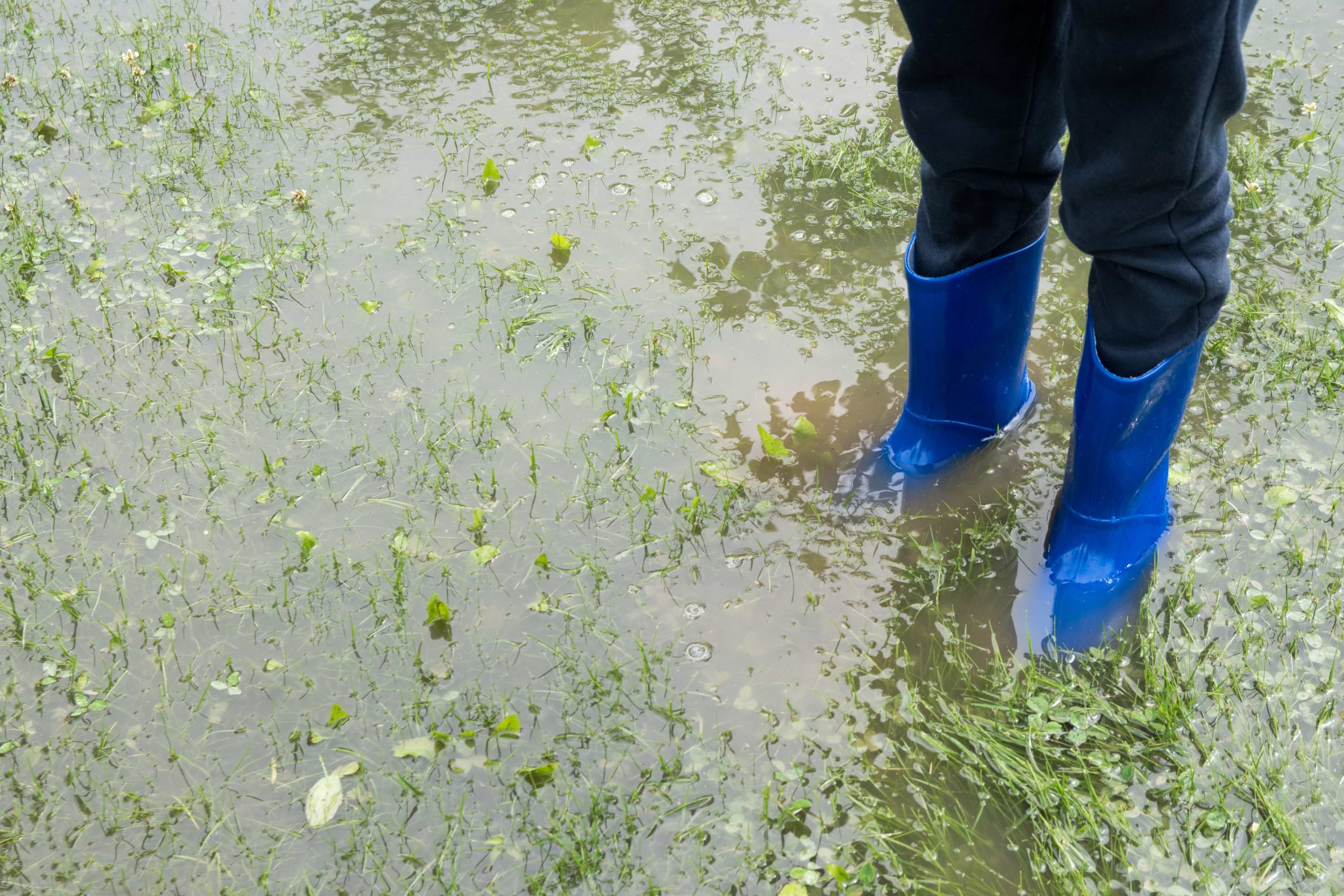
Your roof collects rainfall and sends it into a limited number of gutters and downspouts. That means water that originally fell across thousands of square feet becomes concentrated at just a few corners of the house.
If those downspouts empty beside the foundation, into a flower bed, or onto an eroding slope, the landscape is being asked to absorb a large volume of water in one small area.
According to the University of Georgia Cooperative Extension, one inch of rain produces approximately 623 gallons of runoff for every 1,000 square feet of impervious surface. That means a 2,000-square-foot roof can shed roughly 1,246 gallons during a one-inch rainfall. A 3,000-square-foot roof can produce approximately 1,869 gallons. UGA Extension stormwater guidance
That is not a small puddle.
It is a concentrated drainage load that must be captured, transported, and released correctly.
At Brooks Landscaping, we treat roof runoff as its own water source. We do not assume the lawn will absorb it, and we do not automatically dump it into a perforated French drain.
Our approach is simple: diagnosis before design.
What an underground downspout system actually does
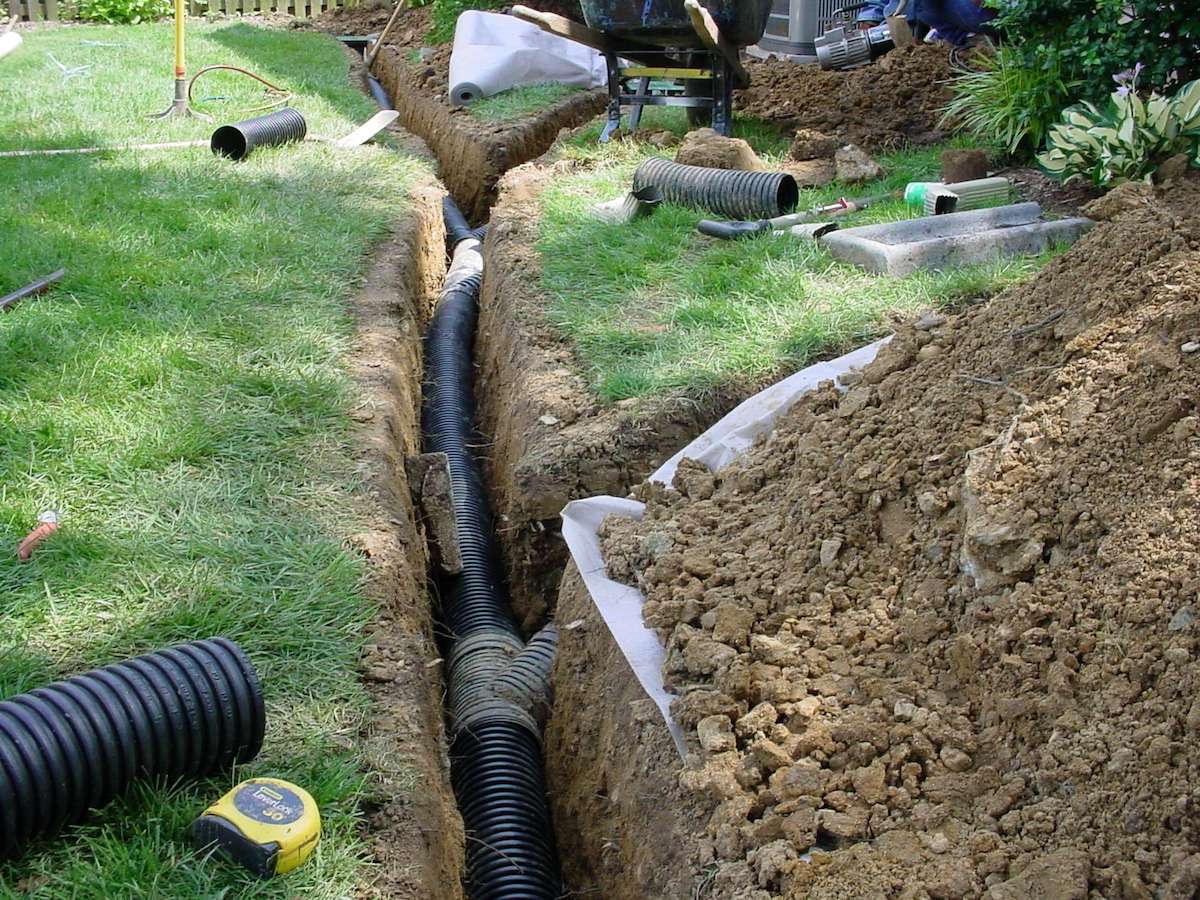
A properly designed underground downspout system connects the gutter outlet to a non-perforated drainage line.
The water enters through a downspout adapter or collection fitting and travels downhill through the buried pipe. Depending on the property, it may discharge through:
- A pop-up emitter
- A daylight outlet
- A protected river-rock outlet
- A dry creek bed
- An approved stormwater connection
- Another site-specific release or storage method
The purpose of the pipe is transportation.
We want the roof water to enter at one point, remain inside the line, and exit at the planned destination.
That is why the pipe is normally solid—or, more accurately, unperforated.
What “solid pipe” means
Homeowners sometimes hear “solid pipe” and assume that it must mean rigid white PVC.
That is not necessarily true.
In landscape drainage, solid means the pipe does not contain slots or holes designed to exchange water with the surrounding soil. Depending on the project, a solid drainage line may be constructed from smooth-wall sewer-and-drain pipe, triple-wall pipe, or appropriate unperforated corrugated pipe.
Material selection depends on:
- Required flow capacity
- Burial depth
- Soil and load conditions
- Number of downspouts
- Length of the run
- Available slope
- Maintenance requirements
- Fittings and outlet design
- Project budget
The essential principle is that concentrated roof runoff should remain contained while it is being transported away.
Why perforated French-drain pipe serves a different purpose
A French drain is designed to collect water from saturated soil.
It normally uses perforated pipe surrounded by washed drainage stone and appropriate filter fabric. Water moving through the soil enters the stone reservoir and then passes through openings in the pipe.
A downspout line does the opposite.
It begins with water already captured by the roof and gutter system. We do not need surrounding groundwater to enter that pipe. We need the roof water to stay inside until it reaches its destination.
Think of it this way
- French drain: Collects water along the length of the trench.
- Solid downspout line: Carries water from a specific inlet to a specific outlet.
- Catch basin: Captures visible surface water at a low point.
- Grading: Shapes the land so water moves in the correct direction.
Each component has a different job.
The NDS technical explanation of French drains similarly identifies their perforated pipe, gravel, fabric, and slope as a system for allowing surrounding water to enter and be guided toward a drainage destination. NDS French-drain guidance
What can happen when roof water enters perforated pipe
Connecting a downspout to perforated pipe is not automatically wrong in every engineered system. However, it should never be treated as the default without understanding the soil, elevations, pipe capacity, and intended function.
Several problems can occur when concentrated roof runoff is placed into a perforated line that was not designed for it.
1. Water can leave the pipe before reaching the outlet
When the surrounding soil is dry and the pipe is relatively empty, water may escape through the perforations into the trench.
In Georgia clay, that water may not infiltrate quickly. It can saturate the trench, soften nearby soil, or reappear as surface moisture.
The homeowner believes the water was carried away when it may have simply been relocated underground.
2. Saturated soil can enter or surround the system
Once the ground becomes saturated, water may attempt to enter through the same perforations. The pipe is then handling roof runoff and subsurface water simultaneously.
If the system was not sized for both sources, capacity can be reduced when it is needed most.
3. Sediment can reduce long-term performance
Poorly constructed perforated systems can allow fine clay particles and sediment to move into the stone reservoir or pipe.
That is why French drains require appropriate stone, fabric, trench construction, and maintenance planning. A piece of perforated pipe buried directly in red clay is not a complete drainage system.
4. The trench can become an unintended storage area
If the outlet is too high, blocked, undersized, or nonexistent, the stone-filled trench can fill with water.
At that point, the system may behave more like an underground bathtub than a functioning drain.
Signs your downspouts are causing landscape problems
Walk around your house during or immediately after a strong rain. Watch what happens at each gutter outlet.
Look for:
- Mulch washing away beneath a downspout
- Soil erosion at the corners of the house
- Water pooling beside the foundation
- Splash blocks that are overwhelmed
- Extensions that have become disconnected
- Water crossing a walkway or driveway
- Soggy grass along one side of the house
- Channels forming downhill from the gutter
- Water collecting near air-conditioning equipment
- Downspouts emptying onto steep slopes
- New sod dying near the discharge area
- Water entering an existing flower bed faster than it can drain
These symptoms may appear to be separate problems, but they often share one source: concentrated roof runoff without a dependable route away from the home.
The parts of a dependable downspout-drainage system
A professional system is more than a pipe hidden under the lawn.
1. A dependable connection
The transition from the downspout to the underground line must capture the water without creating a major restriction.
Some systems use a direct adapter. Others use a low-profile collection device or catch basin where debris, overflow access, or surface water must also be considered.
NDS recommends capturing downspout runoff with an appropriate adapter or collection device connected to drain pipe that conveys the water downstream. NDS downspout guidance
2. Proper pipe capacity
Pipe size should account for the roof area feeding the downspout, rainfall intensity, number of connected downspouts, pipe slope, fittings, and total run.
Connecting several downspouts to one undersized line can create backups even when the pipe was installed correctly.
3. Positive slope
Gravity drainage requires fall.
A pipe that rises and falls beneath the yard can trap water, collect debris, and reduce flow. Small elevation mistakes across a long run can create significant performance problems.
This is why we measure the property rather than assuming it slopes in the direction it appears to slope.
4. Thoughtful fittings
Every sharp turn adds resistance and creates a potential collection point for debris.
The route should be designed to move water efficiently while remaining accessible enough for future maintenance.
5. A safe destination
The outlet is one of the most important parts of the entire system.
A line should not simply:
- End underground without a storage or infiltration design
- Discharge beside a neighboring property
- Empty onto a sidewalk
- Create erosion on a steep slope
- Interfere with a drainage easement
- Send water toward a road or structure
- Release water where it immediately flows back toward the house
The EPA advises homeowners to consider local requirements and the destination of redirected downspout water to avoid unsafe conditions and property damage. EPA downspout guidance
6. Outlet protection
Fast-moving water can erode soil at the discharge point.
River rock, decorative gravel, a dry creek bed, or another energy-dissipation feature may be used to slow and spread the water while protecting the surrounding landscape.
This is one area where drainage and design work together. The outlet can perform correctly without looking like an unfinished construction site.
When a pop-up emitter makes sense
A pop-up emitter remains closed when the system is inactive. As water enters the drainage line, pressure lifts the emitter’s lid and allows the water to release across the surface.
It can provide a clean finish in a lawn where a daylight outlet is not practical.
However, a pop-up emitter still needs:
- Adequate fall
- Sufficient pipe capacity
- A location lower than the downspout connection
- Clearance from structures and sensitive areas
- Routine inspection for grass, roots, sediment, and debris
- Protection from being buried by new sod or landscaping
The emitter is an outlet—not a substitute for proper elevations.
If it sits too high, the upstream line may retain water or fail to discharge completely.
When roof water and yard drainage need to work together
Many properties require more than one component.
For example, a homeowner may have roof runoff entering a low side yard that is also receiving surface water from the backyard.
A complete solution might include:
- Solid underground lines carrying roof water
- Catch basins collecting surface runoff
- Regrading to guide water toward the basins
- A French drain intercepting separate subsurface seepage
- A shared downstream outlet only if the system has been properly designed for the combined flow
- River rock protecting the discharge area
- Sod restoration after the drainage work is complete
The answer is not to force every source of water into one pipe.
The answer is to identify each source, assign the correct collection method, and make sure the complete system can handle the combined demand.
Downspout-drainage mistakes homeowners should avoid
Burying flexible extensions without a complete plan
A buried extension still needs correct slope, connections, capacity, and an outlet. Hiding a pipe does not make it drainage.
Using perforated pipe by default
Perforated pipe has a legitimate purpose, but concentrated roof water normally requires containment and conveyance.
Connecting too many downspouts to an undersized line
The line must be designed for the water feeding it, not merely for the easiest pipe size to purchase.
Skipping cleanout and maintenance planning
Leaves, roofing granules, shingle debris, and gutter material can enter the system. Long lines and complicated routes should be designed with future access in mind.
Ending the pipe beside the property line
A professional solution should protect the homeowner without transferring the problem to someone else.
Covering the problem with decorative stone
River rock can protect and beautify an outlet, but stone alone does not correct a downspout that is discharging in the wrong location.
Homeowner inspection checklist
After the next rain, check:
- Does each gutter remain attached and free-flowing?
- Where does each downspout release?
- Is water pooling beside the foundation?
- Are mulch or soil being displaced?
- Do underground connections overflow?
- Is the lawn unusually wet along the buried route?
- Does the outlet release water freely?
- Is the pop-up emitter blocked by grass or sediment?
- Is the discharge eroding the surrounding soil?
- Does the released water remain on your property?
- Could the proposed route cross utilities or a drainage easement?
- Is the lowest point actually lower than the downspout connection?
Take photos and video while the system is active. Dry-weather pictures often cannot show the pattern that needs to be diagnosed.
Safety, easements, and local approval
Underground drainage requires excavation. Georgia 811 says utility-location requests for mechanized excavation must be submitted at least three business days before digging. Georgia 811
Homeowners should also review their plat, survey, and deed for easements.
Paulding County says property owners should maintain drainage-easement flow paths and may not alter drainage features without prior written approval from the County Engineering Department. Paulding County homeowner stormwater guide
Requirements vary by jurisdiction and property. Site-specific permitting, easement, discharge, and stormwater questions should be confirmed before installation.
Frequently asked questions
Should downspouts use solid or perforated pipe?
Concentrated roof runoff is normally carried through solid, unperforated pipe. Perforated pipe is generally used when the purpose is to collect subsurface water along the pipe’s route.
Does solid pipe have to be rigid PVC?
No. “Solid” means unperforated. The appropriate material depends on the design, load, burial conditions, required capacity, and budget.
Can several downspouts share one pipe?
They can in some systems, but the shared line must have adequate capacity and slope for the combined roof runoff.
Can a downspout drain into a dry creek bed?
Yes, when the creek bed has been designed with suitable capacity, slope, stabilization, and a safe destination. Dumping a downspout into decorative rocks without evaluating the water path is not the same thing.
Why does my underground downspout overflow?
Possible causes include a clogged line, poor slope, an outlet that is too high, insufficient pipe capacity, a blocked emitter, damaged fittings, or debris entering from the gutter.
Can I terminate the pipe underground?
Only when the destination is a properly designed infiltration or storage system appropriate for the soil and water volume. Simply ending the pipe beneath the lawn is not a dependable solution—especially in slow-draining Georgia clay.
How far should downspout water be carried from the house?
There is no universal distance that fits every property. The correct endpoint depends on elevation, soil, foundation conditions, property boundaries, easements, discharge options, and local requirements.
Move roof water before it becomes a yard problem
If one inch of rain can produce more than 1,200 gallons from a 2,000-square-foot roof, your downspouts should not be treated as an afterthought.
They are the beginning of your landscape-drainage system.
At Brooks Landscaping, we evaluate where the roof water starts, how the property slopes, what other runoff enters the area, and where that water can be released safely.
We are not interested in burying a pipe simply to hide the problem.
We design drainage that performs.
Call or text Brooks Landscaping: 678-200-6087
Schedule a consultation: BrooksLandscapingGa.com
Serving homeowners throughout Paulding County, Dallas, Hiram, Kennesaw, Acworth, and nearby northwest Georgia communities.
Brooks Landscaping — We Make Dirt Look Good™
Landscaping That Solves Problems. Designed to Drain. Built to Last.
About the author
Greg Brooks — The Dirt Doctor®
Greg Brooks is the founder of Brooks Landscaping and has spent more than 15 years helping Georgia homeowners solve landscape-drainage, grading, erosion, retaining-wall, stonework, and hardscape problems. His approach begins with understanding how water moves across the entire property before recommending a lasting solution.


