
“Why Mulch Beds Hold Water Against a House: Edging, Settled Soil, Downspouts, and Positive Grade”
A mulch bed beside the house is supposed to frame the landscape—not become a shallow bathtub.
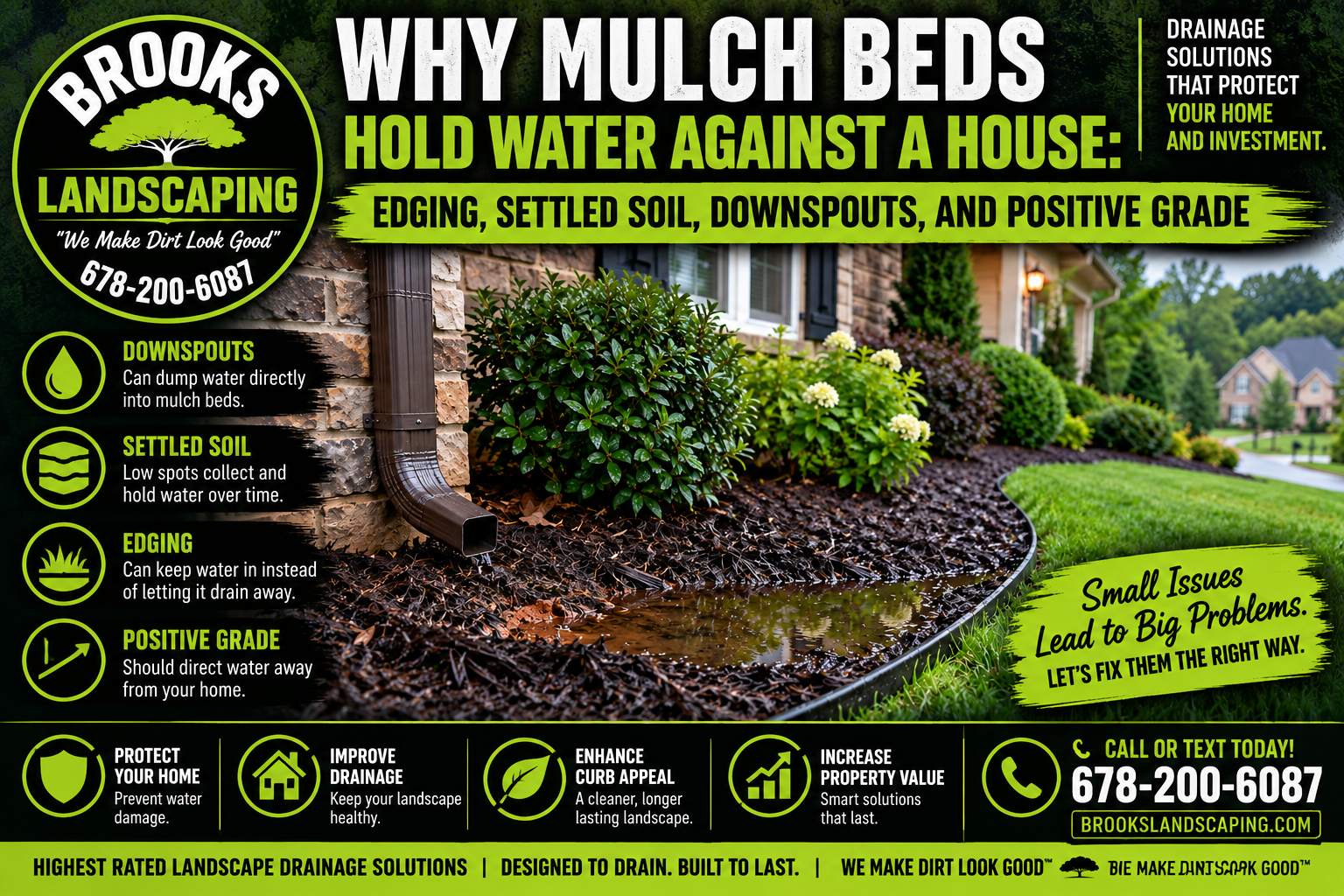
I regularly see water under mulch, behind edging, or moving toward foundations across Dallas, Hiram, Kennesaw, Acworth, and Paulding County. The bed looks neat when dry, then becomes the low point during a Georgia storm.
Mulch is rarely the root cause. The problem is usually underlying soil shape combined with roof runoff, compacted clay, or blocked escape. Adding material or a drain without understanding the path can leave house-side soil saturated.
Why Foundation-Perimeter Water Deserves Attention
Landscape drainage should direct surface water away from the structure. Persistent water beside a slab, basement wall, or crawlspace foundation can contribute to damp soil, erosion, settlement of landscape fill, moisture entry, and recurring damage to plants or mulch.
That does not mean every wet bed proves structural foundation damage. Brooks Landscaping diagnoses and corrects landscape conditions such as grading, runoff, downspout routing, surface collection, and erosion. Cracks, structural movement, active interior leakage, plumbing leaks, failed waterproofing, or serious crawlspace moisture may require evaluation by the appropriate licensed foundation, waterproofing, plumbing, engineering, or building professional.
The goal is to control exterior water responsibly and recognize when the problem extends beyond landscaping.
Diagnostic Signs Beneath the Mulch
Mulch floats or washes into the lawn
Moving mulch proves water is flowing or ponding in the bed. The direction of the displaced material can reveal whether runoff came from the roof, lawn, driveway, or an uphill corner.
Water sits behind edging
Metal, plastic, stone, or concrete edging can act like a small dam. If the lawn outside the bed is lower but the edge has no drainage transition, water remains trapped against the house.
The bed is highest at the lawn and lowest at the wall
This is negative grade. Soil may have settled beside the foundation while mulch was added repeatedly at the outer edge. Water follows the underlying soil surface, not the appearance of the mulch.
Downspouts disappear into the bed
A downspout that ends above ground beside the wall concentrates roof water at the foundation perimeter. A buried line can also leak, clog, separate, or hold water if its route and outlet fail.
Soil remains soft after the lawn dries
Pull mulch aside in a small area without digging. Dark, slick, soft clay several days after rain points to poor drainage or repeated inflow. Georgia clay can hold water beneath a surface that appears dry.
Splash marks or red-clay stains appear on the wall
These marks often reveal runoff striking bare soil or water moving through a low foundation-side corridor. They are useful evidence, but stains alone do not diagnose the source.
Plants decline in a narrow strip near the house
Yellowing, shallow roots, or repeated plant loss may reflect saturated soil. Plant health can have multiple causes, so confirm the drainage pattern before assuming water is responsible.
Six Reasons a Mulch Bed Holds Water
1. Settled soil created a hidden trough
Backfill beside a new foundation can settle over time. Utility trenches and disturbed soil may settle differently from undisturbed ground. Mulch hides these changes, leaving a low channel next to the wall.
The repair is not simply filling the depression with loose topsoil. The finished grade must be evaluated across the entire perimeter so the correction does not bury exterior materials, block drainage details, or push water into another low point.
2. Edging blocks surface flow
Edging can contain mulch, but it can also separate the bed from the lower lawn. During rain, the bed fills until water overtops the border or finds a weak point. Cutting random gaps may cause erosion and mulch loss rather than controlled drainage.
The edge elevation and bed contour should work together. In some areas, the best solution is to reset the edge. In others, a deliberate outlet, catch point, or grading transition is needed.
3. A downspout releases concentrated roof water
Roof runoff can overwhelm a narrow bed quickly. Short splash blocks and flexible extensions may shift or discharge into another foundation-side low spot. Underground routing can be effective when solid pipe, connections, slope, access, and the outlet are designed as a system.
A perforated collection pipe is generally not the right tool for transporting already-collected roof water beside a foundation. The goal is to keep that water contained until it reaches an appropriate discharge point.
4. The lawn slopes toward the house
Sometimes the bed is not producing the water—the yard is delivering it. A raised lawn, builder-created backfall, or settled side yard can send sheet flow into the landscape bed. Installing a drain inside the bed without correcting or intercepting that approach may overload the system.
5. Compacted clay prevents infiltration
Construction traffic, repeated foot traffic, and equipment can compress Georgia clay. Water then perches near the surface. Adding mulch does not loosen the subgrade or create an outlet; it only covers the wet soil.
6. Decorative rock was added without a drainage path
River rock or gravel can reduce splash and improve appearance, but stone does not make water disappear. If the subgrade slopes toward the house or the edge traps water, the rock becomes a clean-looking cover over the same wet condition.
What a Lasting Landscape Correction Must Accomplish
Reestablish positive surface drainage
Where conditions allow, the soil and finished surface should guide water away from the structure toward a stable drainage path. EPA moisture-control guidance describes positive grade away from buildings as a basic water-management principle, while also directing users to meet more stringent local requirements.
Exact slopes, clearances, and permissible grading vary by construction, jurisdiction, and site. Do not raise soil or mulch against siding, brick weep areas, vents, door thresholds, or other building components without qualified guidance.
Control roof runoff separately
Downspouts should discharge away from the foundation through a stable above-ground route or properly installed solid underground line. The outlet must remain lower than the source, accessible when appropriate, and protected against erosion.
Give trapped surface water a destination
Depending on the site, the solution may include selective grading, a shallow swale, a surface basin, solid-pipe conveyance, a pop-up emitter, or a stabilized outlet. A French drain may be appropriate when water is moving through saturated soil, but it should not be the automatic answer to every wet bed.
Restore the landscape after the drainage works
Mulch, gravel, plantings, and sod belong at the end of the sequence. Final materials should preserve the designed grade, keep drainage components serviceable, and resist washout. That is what Designed to Drain. Built to Last means in practice.
Common Fixes That Can Make the Problem Worse
Piling on more mulch
Repeated layers can raise the outer bed, bury plants, conceal low soil, and hold moisture against exterior materials. Mulch is a surface treatment, not grading fill.
Adding topsoil only beside the wall
A narrow ridge may redirect water sideways, bury required clearances, or create a new trough. Grade correction must tie into the surrounding yard.
Installing landscape fabric as waterproofing
Fabric may separate materials or suppress some weeds, but ordinary landscape fabric is not a foundation-waterproofing system. Poorly placed fabric can also redirect shallow water unpredictably.
Connecting roof water to a perforated line
Releasing concentrated roof runoff into foundation-side soil defeats the purpose of conveyance. Downspout routing and subsurface collection perform different jobs.
Cutting the edging without stabilizing the exit
Water may escape through the opening and immediately wash mulch or clay into the lawn. The outlet needs a stable transition.
Assuming exterior grading will repair structural damage
Landscape corrections manage surface and near-surface water. They do not repair cracked foundations, failed structural components, damaged plumbing, or defective building waterproofing.
What Affects Cost and Value?
There is no responsible flat price for “water in a mulch bed.” Cost depends on the length of the affected perimeter, access, excavation, soil condition, downspout quantity, pipe route, outlet distance, edging, plant relocation, utility conflicts, erosion control, and final restoration.
The strongest value comes from separating the causes. A short downspout correction may solve one area, while a settled side yard may require grading and conveyance. Treating every symptom with the same drain wastes money.
Homeowner Rain-Day Checklist
-
Watch safely from a covered location during meaningful rain.
-
Record whether water arrives from the roof, lawn, driveway, or slope.
-
Pull back a small amount of mulch and inspect the soil contour.
-
Compare the bed elevation at the wall, middle, and lawn edge.
-
Look for edging that blocks the lower escape route.
-
Check downspout connections and observe the outlet.
-
Note wall splash marks, sediment deposits, and washed mulch.
-
Review the plat for easements and property boundaries.
-
Contact Georgia 811 before excavation.
-
Escalate structural movement or active interior leakage appropriately.
Frequently Asked Questions
Does mulch cause foundation water problems?
Mulch itself is usually not the main cause. The underlying grade, edging, concentrated runoff, and soil condition control where water travels. Excessive buildup can conceal or worsen those conditions.
Should I replace mulch with river rock?
Rock may reduce washout and splash, but it will not correct negative grade or a failed downspout line. Fix the water path first, then choose the surface material.
Is a French drain always needed beside the house?
No. Surface runoff may be solved by grading or solid downspout conveyance. Subsurface seepage may justify a French drain. The water source determines the tool.
Can I raise the bed so it slopes away?
Possibly, but finished grade must respect exterior wall materials, openings, drainage details, and local requirements. Do not bury the building to improve the landscape slope.
Why does only one corner stay wet?
That corner may receive several roof planes, sit below a downspout, collect cross-slope runoff, or contain settled fill. Observe the corner during rain and trace both the inlet and outlet.
When should I call someone besides a landscaper?
Contact the appropriate qualified professional when you see structural cracking or movement, active interior water intrusion, plumbing leaks, failed foundation waterproofing, significant mold, or conditions beyond exterior landscape drainage.
Control the Water Before Redesigning the Bed
At Brooks Landscaping, we evaluate the grade beneath the mulch, the approaching runoff, downspouts, clay soil, collection options, and outlet as one connected system. That is Landscaping That Solves Problems.
If water is collecting beside your home in Paulding County, Dallas, Hiram, Kennesaw, Acworth, or nearby northwest metro Atlanta, call 678-200-6087 or visit BrooksLandscapingGa.com to request an evaluation. You can’t stop Georgia rain—but you can control where it goes.
Author
Greg Brooks, The Dirt Doctor®
Greg Brooks provides practical homeowner education about landscape drainage, grading, erosion control, drainage-integrated hardscapes, and sod restoration in northwest metro Atlanta. His approach begins with diagnosis before design.


