
“Why Landscape Fabric Shows Through River Rock—and How to Fix It Correctly”
When black fabric begins showing between river rocks, most homeowners reach for one of two quick fixes: rake the stone back over it or buy another load of rock. Either one may improve the appearance for a while. Neither tells you why the stone moved.
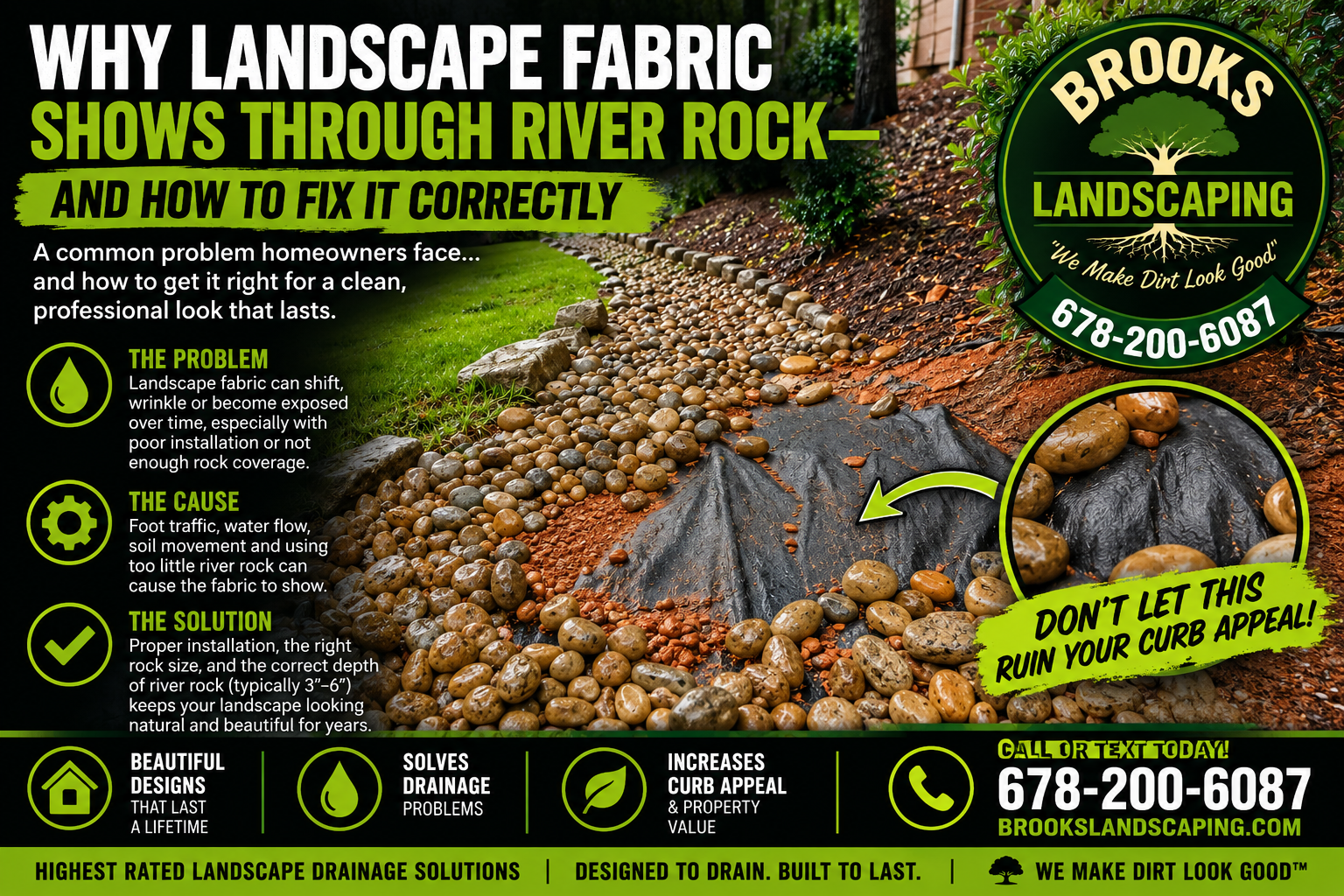
Across northwest metro Atlanta, our hills, roof runoff, intense rain, and red clay can turn a decorative rock bed into a drainage path. If water is moving the stone, covering the fabric simply resets the clock.
I treat exposed fabric as evidence of shallow stone, failed edging, runoff, or an uneven and unstable base.
My rule is diagnosis before design. Before I recommend more rock, I want to know what the water, soil, slope, and edges are doing.
What the Fabric Is Supposed to Do
The material beneath functional river rock cannot make a bad grade behave. Its main job is separation and filtration: keeping soil fines out of the stone while allowing designed water movement.
Federal Highway Administration and NRCS guidance recognize this separation role. Those engineering references are not universal residential specifications: product strength, permeability, overlap, anchoring, and cover still must fit the site. Lightweight weed barrier and drainage-grade geotextile are not automatically interchangeable.
Most important, fabric does not create an outlet, correct a low spot, hold loose rock on an excessive slope, or stop concentrated runoff by itself.
Diagnostic Signs: Read the Pattern Before You Repair It
Fabric appears only on the high spots
If fabric shows across small humps while surrounding stone remains in place, the subgrade may not have been shaped smoothly before installation. Thin stone coverage makes every high spot visible. The problem may be primarily installation depth and surface preparation rather than active erosion.
A narrow exposed strip follows the direction of water
This is a runoff clue. Water may be entering from a downspout, patio edge, uphill lawn, gate opening, or stair corridor. The exposed strip is often the beginning of a channel. Look downhill for displaced stone, red-clay sediment, or a pile of smaller rock at the end.
Fabric is visible along the lawn edge
Stone may be spreading because containment failed or traffic pushed the border outward. Gravity and runoff accelerate it.
Fabric is wrinkled, torn, or pulled above the rock
Wrinkles suggest poor placement, settlement, or stone movement. Tears may come from sharp aggregate, roots, tools, traffic, or lightweight material.
Red clay is appearing on top of the fabric and stone
Soil may be entering uphill or through damaged seams. Adding clean rock over contamination only traps it and reduces drainage space.
The entire rock bed is lower than it used to be
The rock may be settling into soft clay or mixing with soil. Rebuilding support and separation can outperform repeated top-offs.
Why River Rock Moves and Uncovers Fabric
1. The stone layer was too shallow or uneven
A thin layer separates easily during raking, foot traffic, and rainfall. Rounded river rock also does not interlock like angular base aggregate. There is no universal rock depth: stone size, slope, flow, use, base condition, and product guidance all affect the assembly.
2. Concentrated water is using the bed as a channel
Roof downspouts and large uphill areas deliver concentrated flow. If the bed was not shaped, sized, and discharged as a drainage feature, water may sort the stone and expose the underlayment.
You can’t stop Georgia rain—but you can control where it goes. That may require intercepting water before it reaches the bed, routing a downspout through solid pipe, reshaping the path, or converting the area into a deliberately built dry creek bed.
3. The grade beneath the fabric directs water incorrectly
Water follows the subgrade, not the appearance of the finished stone. A low spot beneath the fabric can hold water. A cross-slope can push flow toward one edge. A bed that pitches toward the house remains a grading concern even if attractive river rock hides the soil.
4. Edges do not contain the stone
River rock needs a transition that fits its function. The edge may be a properly shaped soil shoulder, a stone border, hardscape, or another intentional containment detail. When the edge is too low, undermined, or poorly connected to the surrounding grade, rock escapes and fabric appears.
5. The wrong underlayment was used—or it was installed poorly
Very light weed-control fabric may tear under heavy stone, while impermeable plastic can trap water. Inadequate overlap, exposed seams, voids, roots, and debris create weak points. “Fabric” is a category, not a complete specification.
6. Maintenance moved the rock without addressing the source
Powerful leaf blowers, rakes, pets, children, and repeated walking can uncover fabric in localized areas. But if the same line opens after every storm, maintenance is not the primary cause. The repeated pattern is telling you that water has a preferred route.
Match the Repair to the Cause
Regrade and reset a shallow decorative bed
Where runoff is not concentrated and the base remains stable, remove the stone, correct the subgrade, replace damaged separation material, reset the edges, and reinstall clean rock. Do not bury mud, leaves, and clay-contaminated stone in the rebuild.
Correct the water source before rebuilding
If a downspout, patio, or uphill slope feeds the exposed area, manage that source first. Appropriate options within our scope can include:
-
Solid-pipe downspout routing to a suitable discharge point
-
A catch basin at a true surface low point
-
Grading or a shallow swale that spreads or redirects sheet flow
-
A functional dry creek bed designed for the observed runoff
-
A stabilized river-rock outlet that slows water before it reaches vulnerable soil
The right answer depends on elevation and a stable, lawful outlet. A collector without discharge is incomplete.
Rebuild a functional rock channel as a system
A drainage bed needs a shaped subgrade, suitable separator, stable stone, contained edges, and an outlet that accepts discharge without eroding.
That is what Designed to Drain. Built to Last means in practical terms.
Stabilize the edge and surrounding soil
Where stone escapes into lawn or washes from steps, rebuild the boundary and restore soil support. Sod can protect properly graded sheet-flow areas, while river rock may armor the deliberate water path.
Replace failed fabric selectively only when the base is sound
A small tear may accept a compatible overlapping repair if the grade, support, and surrounding material remain sound. Widespread deterioration, contamination, exposure, or unstable clay usually calls for more than spot patches.
Common Repairs That Usually Fail
-
Dumping new rock over fabric: Adds weight without correcting washout or settlement.
-
Using plastic: Can interfere with drainage and does not fix the water path.
-
Pinning fabric in an active channel: Water keeps sorting the stone.
-
Folding fabric back: Creates a ridge without restoring separation.
-
Hiding the edge with mulch: Runoff transports mulch into the rock.
-
Using larger stone without checking the outlet: Water may bypass or undermine it.
What Affects Repair Cost and Value
There is no universal price. Cost depends on access, stone condition, cleaning or disposal, fabric, edging, grading, drainage, outlet work, utilities, and restoration. The real value is correcting the failure mechanism instead of paying for repeated top-offs and cleanup.
Homeowner Checklist
After a safe rain event, document the following:
-
Where water enters the rock bed
-
Whether the exposed fabric forms a line, patch, edge, or high spot
-
Where displaced stone accumulates
-
Whether red clay is on top of the rock
-
Whether the bed slopes toward or away from the house
-
Whether downspouts or hard surfaces feed the area
-
Whether edging has moved or been undermined
-
Whether the outlet is open, stable, and on the property
-
Whether the bed has settled or only shifted at the surface
Before excavation or mechanized grading, use Georgia 811 and account separately for private utilities, which public locators may not mark. Site conditions, easements, property boundaries, and local requirements should be checked before changing a drainage route.
Frequently Asked Questions
Can I just add more river rock over exposed fabric?
You can restore appearance that way, but first determine why the fabric became exposed. More rock may be reasonable for an otherwise stable, shallow bed. It is not a lasting repair for concentrated runoff, failed edging, settlement, or an incorrect grade.
Should landscape fabric ever be visible?
No. Exposed fabric is vulnerable to damage and makes the installation look unfinished. It should remain covered according to the product and system design.
Does exposed fabric mean the fabric failed?
Not necessarily. The fabric may still be intact while the stone above it moved. The exposure pattern helps distinguish surface displacement from torn material, soil migration, or subgrade settlement.
Is river rock enough to stop erosion?
Only when it is part of a design that matches the water. Stone size, channel shape, edges, underlayment, grade, and outlet all matter. Scattered decorative rock placed over an active erosion path can be displaced or undermined.
Should I use woven or nonwoven geotextile?
That choice is site- and product-specific. Separation, filtration, drainage, soil strength, puncture risk, and expected flow all matter. A contractor should match the material to the assembly rather than choose by color or weight alone.
When should I request professional evaluation?
Call when exposure returns after rain, stone is moving downhill, clay is entering the bed, a downspout feeds the area, the grade approaches the home, the outlet is eroding, or the rock borders steps, patios, retaining walls, or other hardscape that may be losing support.
Get a Dirt Doctor® Diagnosis
If landscape fabric is showing through river rock at your home in Paulding County, Dallas, Hiram, Kennesaw, Acworth, or nearby northwest metro Atlanta, Brooks Landscaping can evaluate the water source, grade, stone, underlayment, edges, and outlet as one connected system.
Call 678-200-6087 or visit BrooksLandscapingGa.com to schedule a landscape drainage consultation. We Make Dirt Look Good™ by building Landscaping That Solves Problems.
About the Author
Greg Brooks, The Dirt Doctor®, is the founder of Brooks Landscaping and a northwest Georgia landscape problem-solver focused on residential drainage, grading, erosion control, functional river rock, retaining-wall drainage, paver patios and steps, and landscape restoration. His work begins with diagnosis before design so the finished landscape looks intentional and manages water correctly.


