
“Why a New
Construction Yard Develops Low Spots: Backfill Settlement, Builder Grading, and Final Grade Corrections”
Learn why new-construction yards develop low spots, hold water, and settle and how proper grading, drainage, and soil restoration solve the real cause.
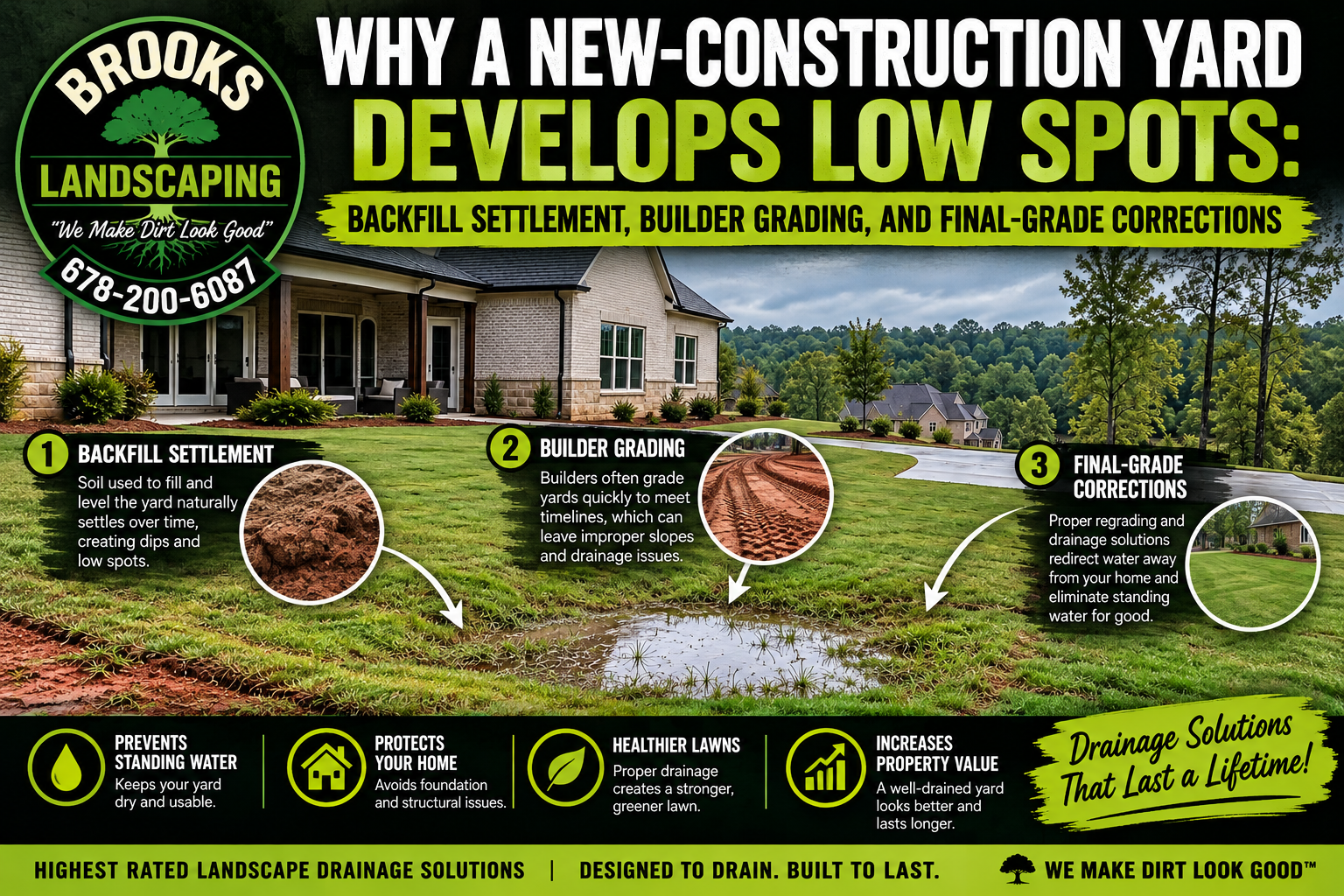
A new-construction yard can look clean and finished on closing day. The sod is green, the ground appears smooth, and there may not be enough established rainfall history to reveal a problem. Then the first wet season arrives. A depression forms beside the driveway, a trench line sinks across the lawn, or water begins standing where the backyard once looked level.
Homeowners often call every one of these problems “bad grading,” but that is not always the complete diagnosis. Some low spots develop because disturbed fill settles. Others come from compacted Georgia clay, missing drainage corridors, poorly blended transitions, or a final grade that was smooth without actually directing water to a safe outlet.
Before I recommend adding soil, installing a catch basin, or cutting a swale, I want to know why the low spot formed and where the water is supposed to go. That is diagnosis before design.
Why New Yards Change After Construction
Building a home disturbs more soil than most homeowners ever see. Excavation, foundation work, utility installation, driveway construction, material storage, and repeated equipment traffic all affect the ground. Soil may be removed from one area, placed in another, and compacted unevenly.
Georgia clay makes these changes visible. Wet clay can be difficult to place consistently, while dry clods may leave hidden voids. Equipment can compress the surface so water runs across it instead of soaking in.
Sod may hide disturbed areas before they finish settling; rainfall and ordinary use reveal them later.
Four Different Problems That Look Like One Low Spot
1. Backfill settlement
Soil placed beside a foundation, utility trench, drain line, wall, or other excavation can lose volume as voids close and moisture conditions change. The surface may sink in a narrow line or defined shape that follows the buried work.
A shallow, stable area may be corrected with compatible soil and restoration. Repeated sinking, open voids, damaged utilities, or structural movement requires an appropriate qualified professional.
2. Incomplete final grading
A yard can be visually smooth and still lack positive drainage. Water may leave the house but enter a broad bowl, hit a raised property-line ridge, or stop behind a sidewalk, fence line, or landscape bed. This is a contour problem, not simply a missing-drain problem.
Final grading should connect high points, low points, and outlets into a deliberate path. Filling only the puddle can push the same water toward the house, patio, neighbor, or another section of lawn.
3. Compacted clay and poor soil transitions
Construction traffic can create dense layers that restrict infiltration and root growth. UGA Extension notes that new-home construction moves and compacts soil, and that grading often removes topsoil and leaves clay subsoil exposed.
Compaction does not always create a visibly lower elevation. It can make an apparently level area stay wetter because rainfall cannot enter the soil normally. Thin topsoil or sod placed directly over clay can also create an abrupt transition where roots struggle and water moves laterally.
4. Concentrated runoff entering the area
The low spot may be real, but incoming water may be the larger issue. Downspouts, uphill lots, driveways, side yards, and neighboring grades can concentrate flow onto one area.
Adding fill without controlling that source can cause erosion, sod failure, or another low spot.
How to Diagnose the Pattern Before Repairing It
Look at the shape
A narrow sunken stripe often follows a utility or drainage trench. A depression beside a foundation may follow disturbed backfill. A wide shallow bowl may point to final grading or equipment traffic. A low edge beside concrete can indicate settlement or an unfinished soil-to-hardscape transition.
Watch a real rain
Observe where water first appears, which direction it travels, and whether the depression fills from rainfall or incoming runoff. Record videos at the start, peak, and end of the storm. The sequence matters.
If water races into the area, source control and surface conveyance may be priorities. If the area darkens slowly and remains soft long after other sections dry, compaction, clay, or subsurface moisture may be involved.
Compare the low spot with the outlet
Every correction needs a workable destination. The lowest visible point is not automatically the proper location for a basin, and a swale cannot drain uphill. Elevation checks help determine whether the yard can be regraded, needs collection and solid-pipe conveyance, or requires a combined system.
Check what lies underneath
Before excavation, identify utilities, private lines, irrigation components, drain routes, and recent construction. Georgia 811 currently directs excavators to submit a locate request at least three business days before digging and to verify all utility responses before work begins. Private facilities may require separate locating.
When Adding Soil Is the Right Repair
Adding soil can work when the depression is shallow, the cause is understood, the underlying area is stable, and the new contour can tie into a positive drainage path.
The repair should not be a loose mound over wet sod. The surface needs preparation, compatible material, controlled placement, shaping, and restoration without creating a hump that blocks runoff.
On trench settlement, pipe support and the condition of buried components matter. If a pipe has sagged with the soil, covering the surface may hide a functional failure. That is why the system should be evaluated before the lawn is rebuilt.
When Regrading Is Better Than Spot Filling
Regrading becomes the stronger solution when several depressions share one cause, the yard has backfall, or the entire drainage corridor lacks continuity.
The goal is not to make every yard perfectly flat. A functional yard uses subtle contours to move water away from structures and through a stable route. Depending on the site, that may include cutting high areas, filling lows, blending slopes, establishing a shallow swale, and stabilizing the finished surface with sod or other appropriate cover.
Regrading must respect property lines, easements, neighboring runoff, utilities, hardscapes, and a safe discharge location. Moving water faster is not an improvement if it creates erosion downstream.
When a Drainage Component Belongs in the Plan
Grading alone is not always enough. A confined low area may not have space for a surface corridor, or an existing hardscape may interrupt the natural route.
- Catch basins collect surface water at defined low points when proper inlet elevation and an outlet route are available.
- Solid pipe conveys concentrated water from downspouts or basins without intentionally saturating the surrounding clay.
- French drains address certain subsurface-water conditions; they are not the first answer for every surface puddle.
- Swales use broad surface contours to move runoff while remaining maintainable and visually integrated.
- Combined systems may use grading to deliver water to collection points and pipe to carry it to a stable discharge area.
Diagnosis determines the tool. Installing a French drain in a surface-flow problem or a basin without a usable outlet does not solve the system.
Common Mistakes in New-Yard Corrections
- Filling the puddle without mapping the drainage path. Water simply moves to the next-lowest area.
- Burying sod under loose soil. The organic layer can create an unstable transition.
- Building soil against siding or vulnerable building components. Landscape grade must respect the home and its drainage details.
- Assuming all settlement is harmless. Deep voids, recurring collapse, structural movement, or utility concerns need specialized evaluation.
- Installing a drain before confirming an outlet. Collection without discharge creates storage, not drainage.
- Using decorative stone to hide wet clay. Stone can stabilize a proper route, but it cannot correct missing fall.
- Restoring sod before the grade is proven. The first hard rain should not be the first test of the proposed contour.
What Affects the Scope and Value of the Project?
Important factors include the size and depth of the settled area, the amount of cut and fill, equipment access, buried utilities, existing sod, soil quality, downspout connections, hardscape crossings, erosion control, and the distance to a stable outlet.
A focused trench-line correction is different from rebuilding an entire drainage corridor. The best value comes from correcting the cause, protecting buried infrastructure, and restoring the finished surface only after the grade and water path work together.
Homeowner Checklist
- Photograph the yard during rain and again after one or more dry days.
- Mark every low spot and note whether it follows a straight buried route.
- Identify downspouts, roof valleys, slopes, concrete edges, and incoming runoff.
- Check whether the ground is low, compacted, or both.
- Find the intended downstream outlet before selecting a solution.
- Watch for recurring holes, open voids, utility issues, or structural movement.
- Request utility locating before excavation.
- Avoid sending concentrated water across a property line.
- Confirm that the finished contour can be stabilized and maintained.
- Seek a site-specific evaluation before major filling or grading.
Frequently Asked Questions
Is some settlement normal around a new home?
Disturbed soil can settle, but “normal” should not be used to dismiss repeated collapse, deep depressions, exposed utilities, structural movement, or water entering the home. Those conditions require proper evaluation.
Can I level a low spot with topsoil?
Sometimes, if the area is shallow and stable and the new grade has a positive path. Topsoil alone should not be used to conceal a void, damaged pipe, or incomplete whole-yard drainage plan.
Why does the new sod stay wet over compacted clay?
Dense clay can restrict infiltration and root development. Water may perch near the surface or move laterally along the soil transition. Soil preparation and final contour must be considered together.
Does a low spot always need a catch basin?
No. Some areas are better corrected by filling and regrading; others need a swale, basin, solid pipe, or combined system. A basin also needs the correct elevation, pipe route, and outlet.
Should I contact the builder first?
If the home is new or warranty coverage may apply, document the condition and contact the builder before altering the area. An independent drainage evaluation can also clarify the physical cause, but contract and warranty questions should be handled by the appropriate parties.
Build the Yard Around a Complete Water Path
At Brooks Landscaping, I do not treat a puddle as an isolated hole. We look at the construction history, soil, contours, water sources, buried route, and outlet before designing the repair. That is Landscaping That Solves Problems—work that is Designed to Drain. Built to Last.
If your newer yard is settling or holding water in Paulding County, Dallas, Hiram, Kennesaw, Acworth, or nearby northwest metro Atlanta, call Brooks Landscaping at 678-200-6087 or visit BrooksLandscapingGa.com to schedule a site evaluation. We Make Dirt Look Good™.
This article is general homeowner education, not a site-specific engineering, structural, utility, legal, warranty, or code opinion. Conditions and local requirements vary; evaluate the property before excavation or runoff redirection.
Author
Greg Brooks, The Dirt Doctor®
Owner of Brooks Landscaping, serving northwest Georgia with practical drainage diagnosis, grading, and durable landscape construction.


