
Driveway Channel Drains Explained: When They Stop Garage Runoff—and When They Don’t
When rainwater runs down a driveway toward a garage, homeowners usually want one simple answer: “Put a drain across it.”
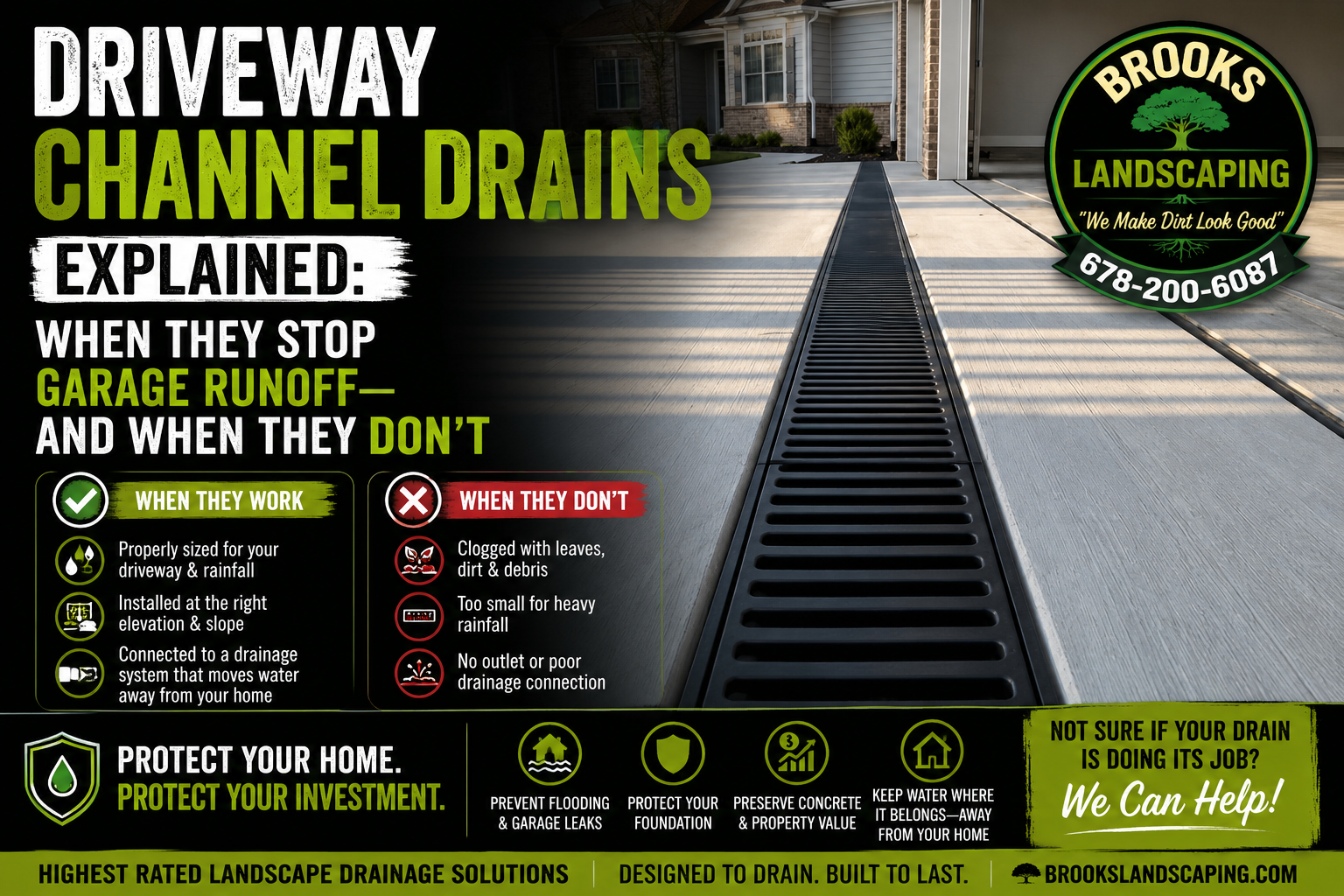
A properly installed channel drain can intercept surface water before it crosses a garage threshold, patio, or walkway. But it is not a magic line in the concrete. It must cross the actual flow path, sit at the correct elevation, handle water and traffic, and connect to a safe outlet.
If the driveway is graded around the drain, the outlet is too high, or hillside runoff is overwhelming the entire area, cutting concrete and adding a grate may only create an expensive place for water to stand.
That is why our approach at Brooks Landscaping begins with diagnosis before design. Before we cut pavement, we follow the water from its source to its final destination.
What Is a Channel Drain?
A channel drain—also called a trench drain or linear drain—is a long, narrow surface inlet covered by a removable grate. Unlike a catch basin, which collects water at one point, a channel drain intercepts water along a line.
That makes it useful across a driveway sloping toward a garage, the low side of a patio, a walkway receiving runoff, a courtyard opening, or the bottom of hardscape steps.
The channel collects the water, but it does not finish the job. An end or bottom outlet must connect it to an appropriately designed drainage pipe and safe discharge point.
Manufacturer guidance describes channel drains as part of a complete system conveying hardscape runoff into downstream pipe. NDS also says traffic, runoff, and application determine the appropriate channel and grate. See the NDS channel and trench-drain guide.
The Difference Between a Channel Drain and a Catch Basin
Both collect surface water, but their collection shapes are different.
A catch basin works best where grading brings runoff to a defined low point. A channel drain works where water crosses a line—such as the full width of a driveway.
On a driveway where water spreads edge to edge, a small square basin may collect some flow while water passes around both sides. A full-width linear drain creates a longer interception edge.
But if the water pools broadly because the entire driveway is flat or depressed, even a long channel may need surrounding grade correction. The inlet can only collect water that reaches the grate.
When a Driveway Channel Drain Makes Sense
A channel drain may fit when pavement clearly slopes toward the garage, water crosses a consistent line, the drain can span the active flow path, a lower lawful outlet exists, and the assembly can support traffic while remaining cleanable.
This is common where the street or upper driveway sits above the garage or construction has altered an older flow path.
New construction is not immune. A driveway can look smooth and professionally finished while containing subtle elevation changes that send rain toward the wrong place.
When the Channel Drain Is Not the First Fix
The real source is hillside runoff
If a slope sends water and sediment onto the driveway, the design may need to begin uphill with grading, a swale, basins, or a dry creek. One grate can clog or overload.
Water is rising from saturated soil
A channel drain collects surface flow. It does not intercept subsurface seepage beneath the driveway or dry a saturated lawn. Those symptoms may require separate grading or subsurface drainage evaluation.
There is no usable outlet
A channel full of water is storage. If the pipe climbs uphill, ends in clay, or releases into another low spot, the system backs up.
The pavement itself is incorrectly graded
If water sits in depressions that never reach the proposed drain, concrete correction or broader regrading may be necessary. More inlet length cannot overcome a high spot between the puddle and grate.
The proposed work enters the public right-of-way
The apron, ditch, curb, and public storm system may fall under government authority. Confirm approval before altering those areas.
What Makes a Channel-Drain Installation Last?
Correct placement
The drain must cross the water before it reaches the protected area. It should span the active flow path so water cannot simply run around the ends.
Finished elevation
The grate should meet the hardscape cleanly so surface water enters without the drain becoming a raised obstacle. The surrounding concrete or pavers must guide water toward the inlet.
Positive internal drainage
Water inside the channel must reach the outlet. Some systems rely on installation pitch; others offer built-in slope. Product instructions and site elevations control the assembly.
Structural support
The channel, grate, anchoring, base, and concrete surround must work together under tire loads. A rated grate over a poorly supported channel still fails.
NDS says load recommendations depend on the product, grate, concrete encasement, and correct installation. Its categories distinguish pedestrian areas from automobile and light-truck traffic. Never assume every metal-looking grate is driveway-rated. See the NDS load-rating recommendations.
A suitable outlet pipe
Collected water typically travels through solid pipe toward a pop-up emitter, protected daylight outlet, dry creek, or other suitable destination. Pipe, slope, runoff, and outlet conditions work together.
Maintenance access
Grates should remain removable so leaves, pine straw, sediment, and driveway debris can be cleared.
Why Channel Drains Fail
The drain stops short of the flow
Water travels around an end and continues toward the garage. A linear inlet needs to intercept the complete active path, not merely the easiest section to cut.
The grate is higher than the pavement
Instead of entering, shallow runoff follows the channel edge or crosses beside it. Even a small elevation error can matter when water is only a thin sheet.
The channel settles or separates
Inadequate support can allow movement under traffic. Joints may open, the grate may rock, or surrounding concrete may crack.
The outlet is undersized or blocked
The channel can collect faster than the downstream system conveys. Water then fills the trench and bypasses the grate.
Sediment is ignored
If muddy hillside runoff reaches the driveway, the channel becomes a sediment trap. The upstream erosion problem and routine cleaning both need attention.
The system discharges in the wrong place
Moving water away from the garage but toward a neighbor, sidewalk, road, retaining wall, or foundation is not a successful drainage plan.
What Affects Cost and Long-Term Value?
There is no honest universal price per foot for an existing driveway.
Cost depends on length, load class, grate, concrete and reinforcement, demolition, haul-off, pipe route, access, utilities, pavement restoration, and grading corrections.
A patio drain is not the same project as a full-width vehicular drain. A cheap channel becomes expensive if it shifts or the concrete surround must be replaced.
Long-term value comes from selecting the system for both water and traffic, then planning the outlet before any concrete is cut.
Homeowner Rain-Day Checklist
During or just after rain, safely document:
Where does the water first enter the driveway?
Does it move as a broad sheet or a narrow stream?
Does the whole driveway slope toward the garage?
Is runoff also arriving from lawn, roof, or hillside areas?
Where are the true low and high points?
Could water travel around either end of a proposed drain?
Is there a lower safe outlet on the property?
Does an existing drain fill, overflow, or remain dry?
Is sediment or landscape debris moving with the water?
Would the work approach a sidewalk, curb, ditch, or right-of-way?
Video during rain is especially useful because the flow pattern may disappear minutes after the storm.
Safety, Utilities, and Local Approval
Cutting and trenching can encounter buried utilities. Georgia 811 says to submit a locate request at least three business days before digging and check responses before excavation. See the current Georgia 811 process.
Review the survey, plat, and deed for easements. Paulding County says drainage features within an easement may not be altered without prior written Engineering approval. Driveway-apron or right-of-way work may have separate requirements. Review the Paulding County Homeowner’s Guide to Stormwater Management and confirm the property locally.
This is general education, not a permit determination or engineered design for a particular driveway.
Frequently Asked Questions
Will a channel drain stop water from entering my garage?
It can when surface water crosses a predictable line, the drain spans that path, and the downstream system has adequate capacity and fall. It cannot guarantee protection from every water source or storm.
Should the drain go directly against the garage door?
Not automatically. Placement depends on grades, threshold details, structural conditions, vehicle use, and where the drain can intercept water most effectively.
Can I use a plastic grate in a driveway?
Only when the complete product and installation are rated by the manufacturer for the expected traffic. Grate material alone does not establish load capacity.
Does the channel need to cross the entire driveway?
It should cross the entire active flow path. On many driveways that means edge to edge, but the correct length comes from observing how water actually travels.
Can a channel drain connect to a pop-up emitter?
Yes, on some gravity systems. The pipe, combined runoff, elevation, emitter location, and discharge area must all support the design.
How often should it be cleaned?
Inspect it routinely and after heavy storms, especially where trees, pine straw, roof debris, or soil reach the pavement. Cleaning frequency depends on what enters the grate.
When should I request a professional evaluation?
Call when water reaches the garage, the driveway has multiple low points, the outlet is unknown, hillside runoff carries sediment, vehicles cross the proposed drain, or work approaches a foundation, right-of-way, utility, wall, or neighboring property.
Capture the Water Before It Reaches the Problem
A channel drain can be one of the cleanest ways to protect a garage or hardscape from surface runoff—but only when the drain is part of a complete plan.
At Brooks Landscaping, we evaluate the water source, driveway elevations, channel location, traffic demands, downstream pipe, outlet, and restoration before recommending the cut. That is how we build Landscaping That Solves Problems—Designed to Drain. Built to Last.
For driveway, patio, walkway, grading, or landscape-drainage problems in Paulding County, Dallas, Hiram, Kennesaw, Acworth, and nearby northwest metro Atlanta, call Brooks Landscaping at 678-200-6087 or visit BrooksLandscapingGa.com.
Brooks Landscaping — We Make Dirt Look Good™
Author Box
Greg Brooks, The Dirt Doctor®
Greg Brooks is the founder of Brooks Landscaping and helps northwest Georgia homeowners solve residential drainage, grading, erosion, and drainage-integrated hardscape problems. His work begins with diagnosis before design: identify the complete water path, choose the right collection method, and build the landscape or hardscape to perform.


