
Sometimes they are right. But many times, they are trying to choose a solution before anyone has diagnosed the actual problem.
A French drain is designed to manage water moving through saturated soil. A catch basin collects visible surface water. An underground downspout system controls concentrated roof runoff. Grading changes the direction water travels across the property.
Those are four different jobs.
Installing the wrong system can leave the homeowner with the same puddle, the same erosion, and a new bill. That is why our approach at Brooks Landscaping is always diagnosis before design.
Before we recommend anything, we need to understand:
- Where is the water coming from?
- Is it traveling above ground or below ground?
- Is it concentrated roof runoff or water spread across the yard?
- Does the property have enough fall to move water?
- Where can the water legally and safely discharge?
- Is the soil preventing infiltration?
- Is the landscape directing water toward the house?
You can’t stop Georgia rain—but you can control where it goes. Here is how we determine what type of drainage solution a property actually needs.
Why Georgia yards experience so many drainage problems

When a catch basin is the right solution
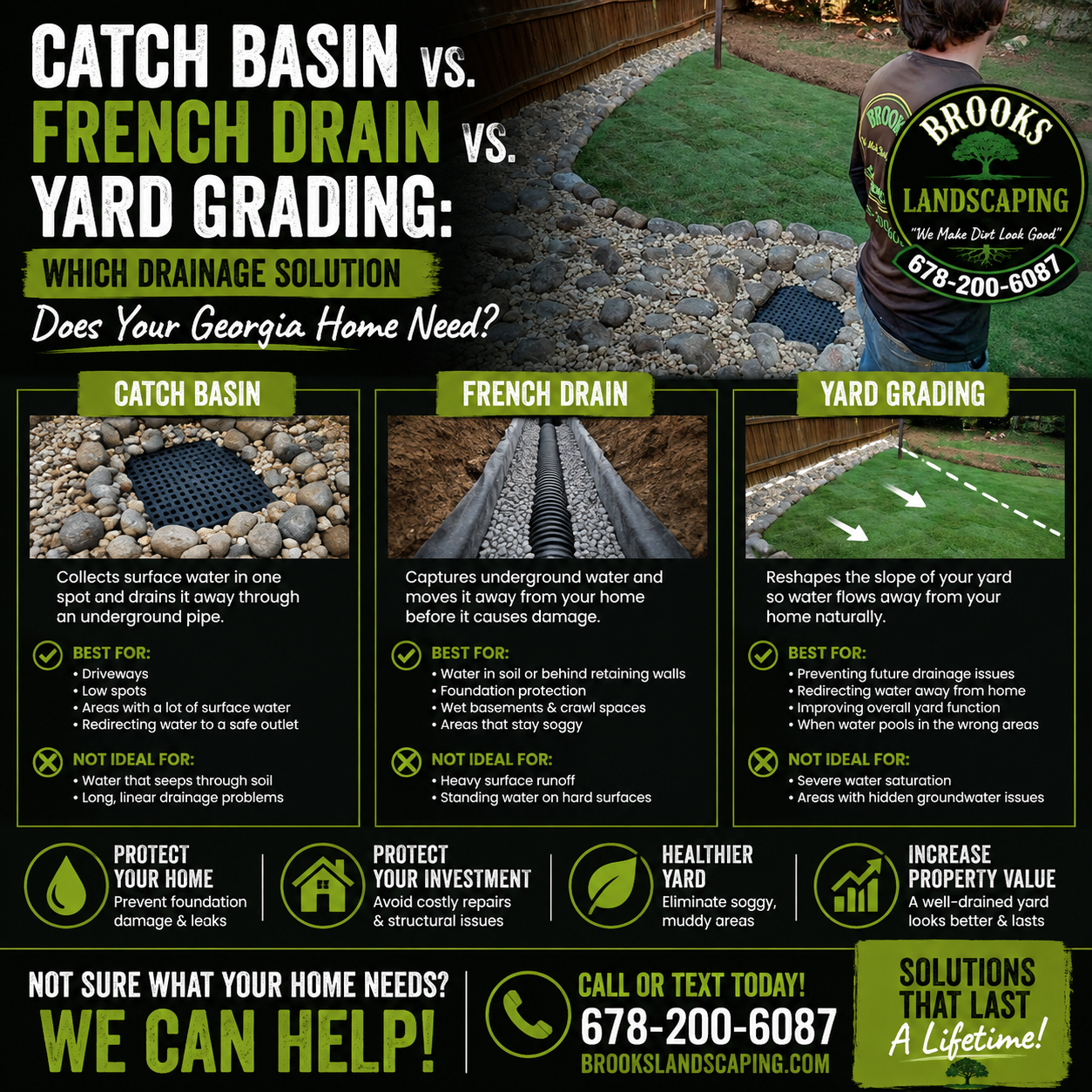
A catch basin is designed to collect surface water at a specific low point.
Imagine water flowing across the lawn and gathering in one visible puddle. If the surrounding grade naturally carries that water into a defined area, a properly positioned catch basin can capture it and move it through a solid underground pipe to an approved discharge location.
A catch basin may be appropriate when:
- Water collects in one identifiable low spot.
- Runoff flows across a driveway, patio, or walkway.
- Several surface-water paths meet in the same area.
- Water pools near a hardscape edge.
- A downspout or swale sends concentrated water toward one collection point.
- The property has enough elevation change to support positive drainage.
The important word is surface.
A catch basin can collect water that reaches its grate. It cannot magically remove moisture trapped throughout an entire section of saturated soil.
The common catch-basin mistake
One frequent mistake is placing a drain box in the middle of a flat, soggy yard without correcting the grade around it.
If the surrounding ground does not direct water toward the basin, the drain may remain dry while puddles form several feet away. The basin is not necessarily defective; the landscape was never shaped to feed it.
A catch basin usually works best as part of a complete system that includes correct elevations, solid conveyance pipe, accessible cleanouts where appropriate, and a dependable outlet.
When a French drain is the right solution
A French drain is primarily used to intercept and redirect subsurface water.
The system generally includes a perforated pipe installed within a properly designed stone-filled trench. Filter fabric helps separate surrounding soil from the drainage stone. As water moves through saturated soil, it enters the stone reservoir and perforated pipe, then travels toward a lower discharge point.
A French drain may be appropriate when:
- The ground remains soggy long after visible puddles disappear.
- Water seeps through a hillside or slope.
- A section of lawn feels soft or spongy for days.
- Subsurface water affects a retaining wall or planting area.
- Water migrates underground from a higher neighboring property.
- The problem follows a long line instead of collecting at one small point.
French drains are valuable, but they are also commonly misunderstood.
They are not designed to act like a surface inlet during a sudden storm. If several gallons of roof runoff are dumping onto the lawn at once, that water should usually be captured and transported through a solid pipe rather than deliberately introduced into a perforated French-drain line.
The common French-drain mistake
One of the biggest mistakes I see is a shallow trench filled with decorative gravel and a piece of perforated pipe laid directly in clay.
That is not automatically a working French drain.
The system requires proper depth, adequate stone, suitable fabric, consistent slope, and a reliable destination for the collected water. The outlet matters just as much as the trench.
If there is nowhere for the water to go, the contractor has not created drainage. He has created underground storage that may eventually fill and back up.
When underground downspout drainage is the right solution
Roof runoff is one of the most concentrated water sources around a home. A large roof can deliver a tremendous amount of water to a few downspout locations during one Georgia thunderstorm.
If that water is released beside the foundation, into a flower bed, or onto an eroding slope, it can create problems that look like general yard drainage failures.
A downspout system may be appropriate when:
- Mulch or soil washes away beneath the gutter outlet.
- Water pools near a corner of the foundation.
- One side of the yard floods during heavy rain.
- Existing extensions discharge onto a walkway or driveway.
- A short splash block cannot carry water far enough away.
- The yard has a safe downhill discharge point.
Downspout water is normally conveyed through a solid pipe because the goal is transportation, not absorption along the route. Depending on the property, the system may terminate through a pop-up emitter, daylight outlet, dry creek bed, or another approved method.
The EPA also warns that redirecting downspouts is not appropriate in every location; the destination must be considered carefully to avoid property damage or unsafe conditions. EPA downspout guidance
When grading is the real solution
Sometimes the pipes are not the primary problem. The shape of the land is.
If the yard slopes toward the home, a drain can help manage the symptom, but the landscape may still be encouraging water to travel in the wrong direction.
Professional grading reshapes the surface so water moves away from vulnerable structures and toward a controlled collection or discharge area.
Grading may be necessary when:
- Water consistently travels toward the foundation.
- The yard contains broad, shallow depressions.
- New sod was installed over an incorrect grade.
- A patio, walkway, or wall interrupted the original flow path.
- Several drain boxes would otherwise be needed across one area.
- Water cannot reach an existing drain because the elevation is wrong.
- Erosion has changed the slope over time.
Grading does not mean making every yard perfectly flat. A flat yard often creates more drainage trouble because water has no direction.
The objective is to create positive, controlled movement without sending the problem onto a neighbor, road, drainage easement, or protected area.
Why many homes need a combined drainage system
Real properties rarely present one isolated problem.
A hillside home may have:
- Roof water concentrated at the foundation
- Surface runoff moving across the lawn
- Subsurface seepage coming through the slope
- A low point beside the patio
- Erosion forming along the natural water path
One product cannot solve all five conditions.
A properly designed combination might include:
- Solid underground lines for the downspouts
- A catch basin at the patio’s low point
- A French drain intercepting hillside seepage
- Minor regrading to establish positive flow
- A river-rock dry creek bed protecting the final surface outlet
- Sod restoration after the drainage work is completed
This is what I mean when I say we design the entire system.
A successful drainage project must capture the correct water, move it through the correct material, and release it at the correct location.
How The Dirt Doctor® diagnoses a drainage property
1. Identify every water source
We look at the roof, neighboring elevations, slopes, driveways, patios, retaining walls, and natural runoff entering the property.
2. Separate surface water from subsurface water
Visible runoff and soil saturation behave differently. Confusing them often leads to the wrong type of pipe or collection system.
3. Measure the elevations
Water moves according to gravity. Before recommending a line, basin, or creek bed, we need to know whether the proposed route has sufficient fall.
4. Examine the soil
Georgia clay changes how quickly water can infiltrate. Compacted soil, buried construction debris, and previous fill work can also affect performance.
5. Determine the destination
We do not stop the plan at the pipe. We determine where the water will leave the system without damaging the home, neighboring property, road, or existing infrastructure.
6. Check practical and legal constraints
Utility locations, recorded easements, stream buffers, property boundaries, wall heights, and local permitting requirements may affect what can be installed.
Georgia law requires notification before mechanized excavation so underground utilities can be marked. Georgia 811 states that requests should be made at least three business days before excavation. Georgia 811 safe-digging guidance
Site-specific permitting and drainage-easement questions should also be confirmed with the governing city or county before work begins.
Five drainage mistakes homeowners should avoid
1. Choosing the product before identifying the water
A French drain, catch basin, or dry creek bed should be prescribed because it fits the problem—not because it is popular.
2. Combining downspouts with perforated pipe without a sound design
Concentrated roof water and subsurface drainage serve different purposes. Combining them carelessly can overwhelm the system.
3. Ignoring the outlet
Every drainage plan needs a safe destination. A pipe that ends underground without proper storage, infiltration, or discharge planning may fail.
4. Sending water onto another property
Moving the puddle across the property line is not a professional drainage solution.
5. Installing sod before correcting drainage
Fresh sod can temporarily hide poor grading, but the next series of storms will reveal the underlying problem.
Homeowner drainage checklist
After the next rain, walk the property safely and document:
- Where water first enters the yard
- Every active downspout outlet
- Areas where water flows across the surface
- Puddles remaining after the storm
- Soggy areas that remain after visible water disappears
- Erosion, exposed roots, and washed-out mulch
- Water moving toward the foundation
- Standing water near walls, patios, and steps
- The lowest safe area on the property
- Any visible drainage easements, ditches, or storm structures
Photos and videos taken during rainfall can be extremely helpful because drainage patterns may disappear before a contractor arrives.
Frequently asked questions
Is a catch basin better than a French drain?
Neither is universally better. Catch basins collect concentrated surface water, while French drains intercept subsurface moisture. The correct choice depends on how the water reaches the problem area.
Can a French drain fix every soggy yard?
No. A soggy yard may be caused by improper grading, roof runoff, compacted soil, subsurface seepage, or several conditions working together.
Can grading solve drainage without installing pipe?
Yes, on some properties. If water can be directed safely across the surface through proper elevations, a grading or swale solution may be enough. Other properties require collection and underground conveyance.
Should downspouts connect to a French drain?
Not automatically. Roof runoff is normally moved through solid pipe. Whether different components can share an outlet must be determined through a site-specific system design.
Where should a drainage pipe discharge?
That depends on the property’s elevation, easements, boundaries, local requirements, and available outlet. Water should never be redirected in a way that damages neighboring property or creates a public hazard.
How do I know which solution my home needs?
Observe the property during rain, document what happens, and have the entire water path evaluated—not just the location of the puddle.
Let The Dirt Doctor® diagnose the problem before you buy the solution
If your yard stays soggy, your mulch keeps washing away, or water is moving toward your foundation, do not start by asking which pipe to purchase.
Start by identifying what the water is doing and why.
Brooks Landscaping provides professional landscape-drainage solutions throughout Paulding County, Dallas, Hiram, Kennesaw, Acworth, and surrounding northwest Georgia communities.
Call or text Brooks Landscaping: 678-200-6087
Learn more or schedule a consultation: BrooksLandscapingGa.com
Brooks Landscaping — We Make Dirt Look Good™
Landscaping That Solves Problems. Designed to Drain. Built to Last.
About the author
Greg Brooks — The Dirt Doctor®
Greg Brooks is the founder of Brooks Landscaping and has spent more than 15 years helping Georgia homeowners understand and solve difficult landscape-drainage, grading, erosion, and hardscape problems. His approach begins with reading the property, identifying how water moves, and designing solutions that protect the home while improving the landscape.


