
“Why Mulch Beds Hold Water Against a House: Edging, Settled Soil, Downspouts, and Positive Grade”
When homeowners see water coming through a retaining wall, the first reaction is usually, “The wall is leaking.” But some water movement can mean drainage is working.
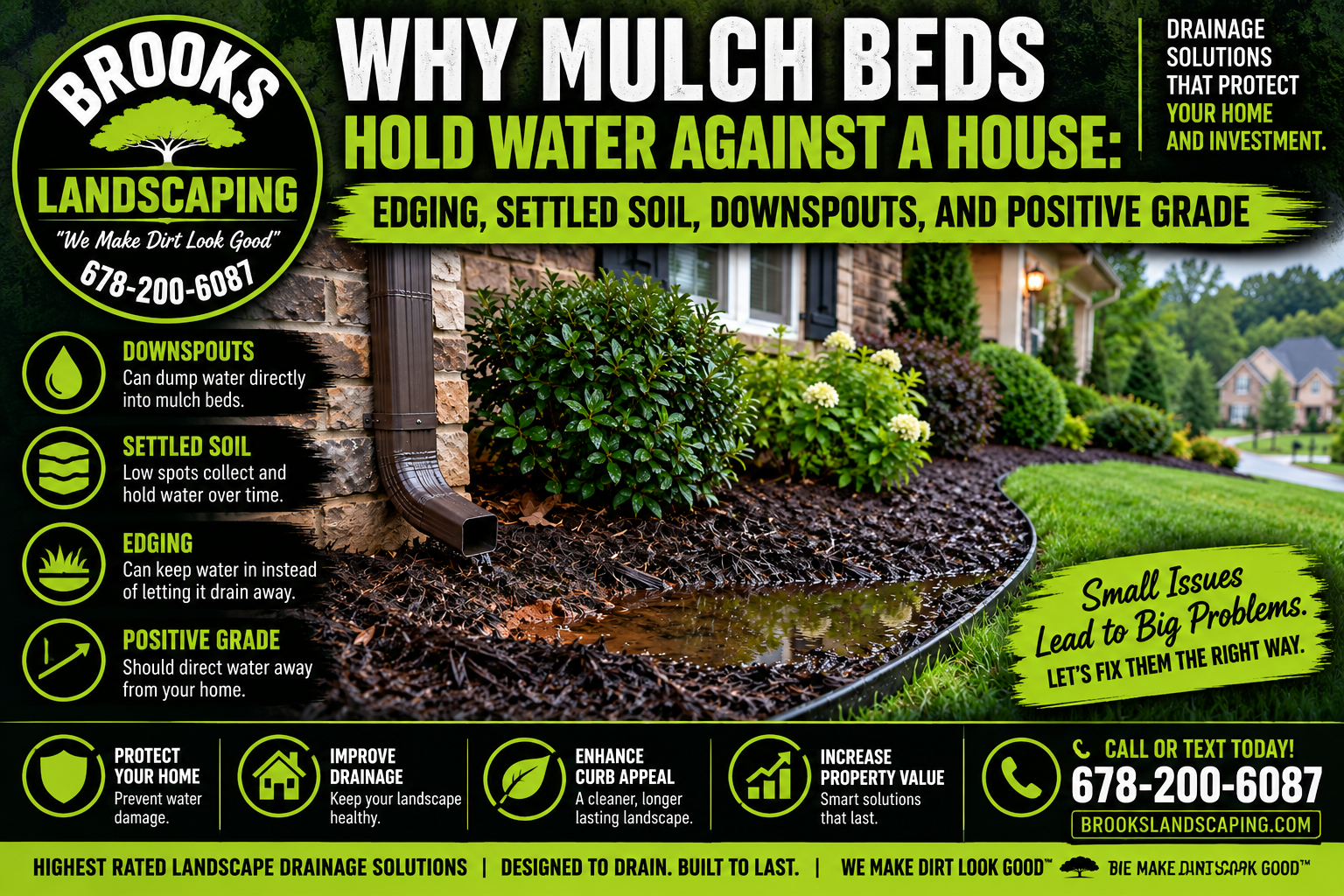
Ask where water appears, when it starts, whether it carries soil, and whether the wall moved. Clear outlet flow after rain differs from muddy water pushing through a crack near bulging blocks.
In Paulding County, Dallas, Hiram, Kennesaw, and Acworth, hills, dense Georgia clay, roof runoff, and builder-shaped slopes can send a lot of water toward a wall. My approach is diagnosis before design: understand the uphill water source, the material behind the wall, and the complete outlet path before calling the seepage normal or recommending work.
Why retaining walls need drainage
A retaining wall holds back soil at a change in elevation. Rainwater moving through that retained soil adds weight and pressure. If the water cannot escape, it can saturate backfill, soften supporting soil, transport fine clay, and increase the force acting on the wall.
A segmental landscape wall relies on a system that may include free-draining aggregate, separation fabric, drainage pipe, planned outlets, compacted fill, and surface grading. Design depends on wall type, loads, soils, manufacturer requirements, and site conditions.
Dry-stacked segmental block walls may also release some moisture through their joints. That does not remove the need for proper drainage behind and around the wall.
When seepage may show drainage working
Water discharge is often expected at a visible pipe outlet or designed opening after rain. More reassuring signs include:
clear water rather than muddy water;
flow beginning during or shortly after rainfall;
discharge occurring at a known outlet;
flow tapering as the retained soil drains;
no new settlement, bulging, rotation, or separated blocks; and
a stable receiving area that does not erode.
Even an intended outlet needs inspection. If water pools at the base, causes erosion, or runs behind the wall again, the outlet path is incomplete.
Warning signs that deserve closer evaluation
Muddy water or red-clay staining
Clear water can become discolored by surface contact, but persistent muddy discharge may indicate that fine soil is migrating through the drainage zone or a failed separation detail. Soil loss can create voids behind the face and settlement above the wall.
Look for sinking soil or pavers, open joints, washed mulch, or cavities above.
Seepage concentrated in a new location
Water suddenly appearing from one joint may mean an outlet is blocked, a pipe has separated, or uphill runoff has found a new path. Compare the location with downspouts, swales, patios, steps, and low spots above the wall.
A wall that bulges, leans, or rotates
Movement changes this from routine drainage maintenance to a stability concern. A wall leaning outward, developing a belly, opening at corners, or showing stepped separation should be evaluated before anyone excavates behind it.
Do not assume opening a new hole will make a moving wall safe. Drainage, foundation support, backfill, reinforcement, loads, or construction details may contribute.
Water that continues in dry weather
Long-lasting flow can point to irrigation, a leaking private line, groundwater, or another source beyond stormwater. Identify it before adding a landscape drain.
Erosion or settlement at the base
An outlet can drain while damaging the wall area. Concentrated discharge onto clay may cut a trench or wash soil from the toe. It needs stabilization and a safe downstream path.
Common causes of retaining-wall drainage trouble
Surface water enters from above
The best wall drain can be overwhelmed when uphill grade funnels runoff toward it. Downspouts, patios, hillside sheet flow, and compacted lawn can all add water.
Surface grading should redirect water before it saturates the retained zone. Regrading, a swale, catch basin, solid-pipe downspout route, or combined system may be appropriate.
Drainage aggregate is missing or contaminated
Free-draining stone creates a path toward the outlet. If mixed with clay or clogged by migrating fines, water movement slows. Surface stone does not rebuild the hidden drainage zone.
The drainpipe has nowhere to discharge
A pipe behind the wall is not useful merely because it exists. It needs workable fall, open outlets, and a stable receiving area. A capped, crushed, buried, or uphill outlet can leave water trapped behind the wall.
Outlet openings are blocked
Mulch, roots, sediment, turf, insects, and decorative stone can cover outlets. Some homeowners bury them because they look unfinished. A drainage outlet must remain visible and serviceable.
The wall sits in a larger drainage corridor
Sometimes the wall is simply where the yard’s water becomes visible. Builder grading, slopes, driveways, and roof water may converge there. Treating one wet joint without addressing that drainage area is a quick fix.
How I diagnose the problem
I start uphill and work down. First, I identify every water source reaching the retained area. Then I look at surface grades, downspouts, hardscape pitch, soil settlement, visible drainage stone, pipe outlets, and the ground below the wall.
Rain timing matters. Immediate flow from a known outlet can be normal. Delayed muddy seepage with settlement above suggests soil migration or trapped water. Flow tied to one downspout narrows the source.
I separate drainage symptoms from structural warnings. Landscape work can redirect runoff, restore grading, rebuild appropriate outlets, and stabilize discharge. Significant movement, critical loads, or engineered reconstruction require the appropriate qualified professional and local review.
Solutions within a complete water plan
Control uphill runoff
Route roof water in solid pipe, restore positive grades, intercept concentrated surface water, or create a stable conveyance path. Reducing unnecessary inflow is often more effective than asking the wall drain to handle everything.
Restore serviceable outlets
Clear blocked terminations, verify the pipe route, correct accessible damaged sections, and keep outlets visible. Water leaving the system must reach a stable area without returning to the wall.
Stabilize discharge
Functional river rock or another erosion-control transition can protect soil below an outlet. Decorative gravel scattered over clay is not automatic scour protection.
Rebuild the drainage zone when necessary
If contaminated stone, soil migration, failed fabric placement, or damaged pipe is confirmed, portions of the wall or retained area may require careful reconstruction. This is not a “dig behind it and see” project when wall stability is uncertain.
Restore the surrounding landscape
After drainage corrections, final grading, soil preparation, and sod or bed restoration should preserve the water path. A beautiful finish that buries outlets or recreates a low spot is not finished correctly. That is how we Make Dirt Look Good™ while keeping it functional.
Common mistakes
Sealing every wet joint and trapping water behind the face.
Drilling random holes without understanding wall construction.
Extending an outlet uphill or into another low spot.
Adding gravel only at the surface while clay remains behind the wall.
Connecting roof water directly into an uncertain wall drain.
Ignoring muddy discharge because “walls are supposed to drain.”
Excavating behind a leaning wall without a stability plan.
Repairing the wall while leaving the uphill runoff source unchanged.
Cost and value factors
There is no responsible flat price for retaining-wall seepage. Cost depends on the source of water, wall type and accessibility, drainage condition, outlet route, excavation limits, utilities, erosion damage, reconstruction needs, and landscape restoration.
A clogged visible outlet may be a focused maintenance repair. Rebuilding drainage behind a moving wall is a different scope. The value is in identifying whether the need is surface-water control, outlet repair, drainage-zone reconstruction, structural evaluation, or a coordinated combination.
Homeowner checklist
Photograph the wall before, during, and after rain from a safe location.
Note whether the water is clear, cloudy, or carrying red clay.
Identify visible outlets and keep them uncovered.
Check for bulging, leaning, separated blocks, or open corners.
Look for sinking soil, pavers, or beds above the wall.
Trace nearby downspouts and uphill runoff paths.
Inspect the outlet area for erosion or ponding.
Avoid digging beside a moving wall.
Call Georgia 811 before excavation.
Request an uphill-source-to-downstream-outlet evaluation.
Frequently asked questions
Is water coming through retaining-wall blocks normal?
Some moisture can pass through joints in dry-stacked segmental walls, and intended outlets should discharge. Whether it is normal depends on flow location, sediment, duration, outlet condition, and wall movement.
Should I seal the joints?
Not as a blind first response. Sealing the visible exit without restoring drainage can trap water behind the wall. Diagnose the system first.
What does muddy seepage mean?
It can indicate soil fines moving with water, erosion above, contaminated drainage aggregate, or another source. Look for settlement and obtain an evaluation before voids expand.
Can a French drain fix water behind the wall?
A French drain may help with certain subsurface-water conditions, but it cannot correct every wall-drainage defect. Surface runoff, downspouts, wall backfill, base conditions, and outlet elevation must be considered.
When is seepage urgent?
Treat active movement, rapid bulging, falling units, significant soil loss, sudden high-volume flow, or a wall supporting critical loads as warning conditions. Keep people away and contact the appropriate qualified professional.
Do retaining-wall repairs require permits or engineering?
Requirements vary by jurisdiction, wall height, location, loads, and scope. Confirm the current rules for the property rather than relying on a universal threshold.
Schedule a retaining-wall drainage evaluation
If water is appearing around a landscape retaining wall, Brooks Landscaping can evaluate uphill runoff, wall-adjacent grading, drainage outlets, erosion, and the surrounding hardscape. We serve Paulding County, Dallas, Hiram, Kennesaw, Acworth, and nearby northwest metro Atlanta.
Call 678-200-6087 or visit BrooksLandscapingGa.com to schedule an evaluation. You can’t stop Georgia rain—but you can control where it goes. Our standard is Landscaping That Solves Problems—Designed to Drain. Built to Last.
Author
Greg Brooks, The Dirt Doctor®
Greg Brooks is the owner of Brooks Landscaping and helps homeowners across Paulding County and northwest metro Atlanta solve landscape drainage, grading, erosion, retaining-wall, and drainage-integrated hardscape problems. His approach follows water from source to stable outlet before recommending work.


