Why Soil Washes Out Beside Outdoor Steps: Edge Erosion, Missing Support, and How to Stabilize the Stair Corridor
A narrow strip of missing soil beside outdoor steps can look like a small landscape problem. I do not treat it that way.
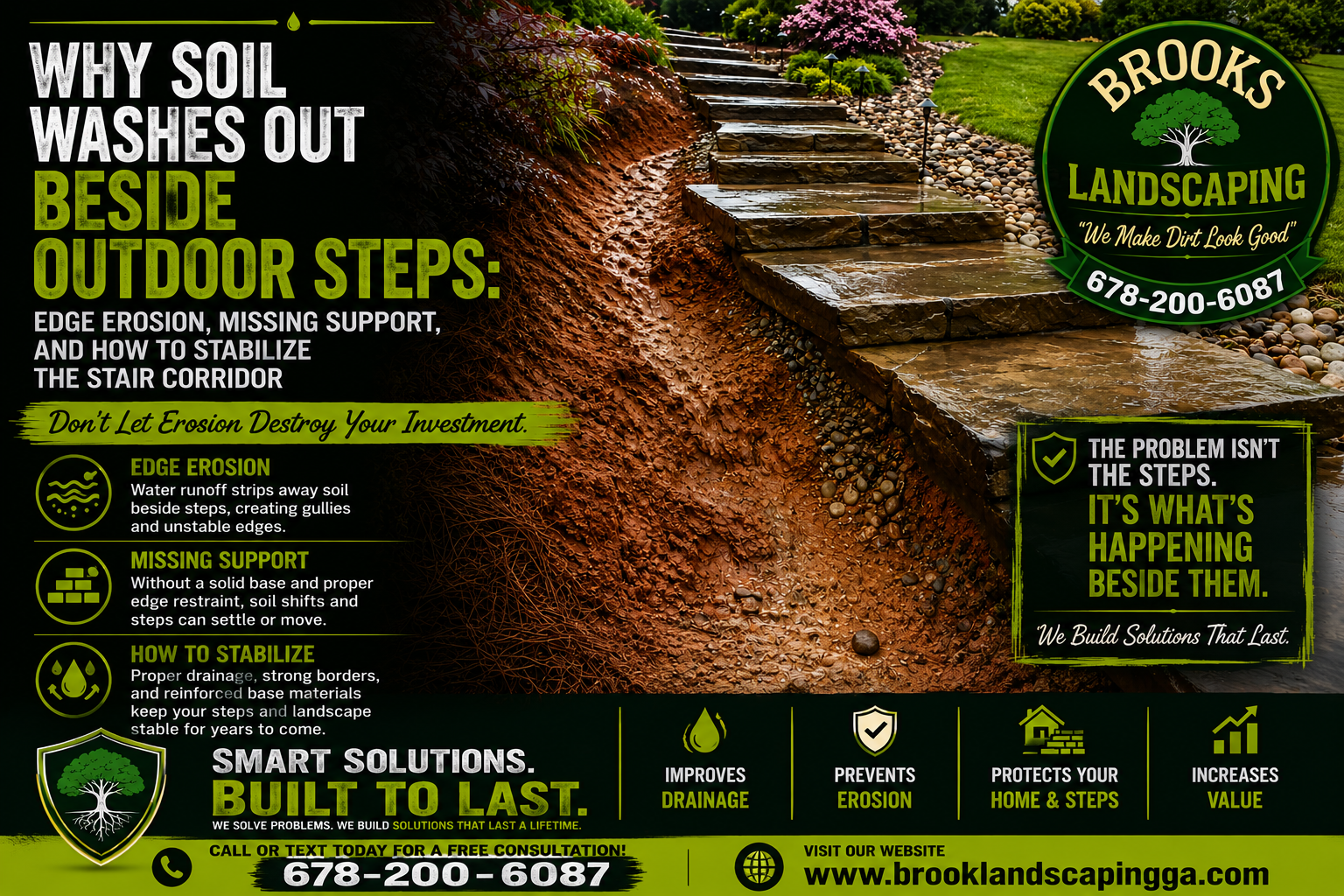
The washout may show that runoff is using the stair edge as a channel, the grade was never stabilized, or water is removing supporting material. Another shovel of dirt may improve the appearance until the next hard rain, but it does not change the water path.
This is common across northwest metro Atlanta. Georgia red clay can look stable while dry, then soften when runoff follows the same narrow edge storm after storm.
My rule is diagnosis before design. Before adding soil, rock, sod, or drainage, determine whether the problem is surface erosion, lost hardscape support, subsurface seepage, or a combination.
Why Step Edges Are Vulnerable to Erosion
The transition between constructed steps and natural soil is often the corridor’s weakest point.
The steps may have compacted aggregate and perimeter containment, while the hillside contains clay, fill, topsoil, sod, or mulch. Differential settlement and water in that seam can form a narrow erosion path.
Once a channel appears, it collects more water and accelerates soil loss.
Diagnostic Signs: What the Washout Is Telling You
Inspect after rain, but avoid wet or unstable steps. Start uphill and follow clay streaks, flattened grass, displaced mulch, and exposed stone.
A shallow groove runs parallel to the steps
This indicates surface runoff traveling along the stair edge, with the hardscape acting as one side of a channel.
Aggregate is visible beneath the outer edge
Exposed base means erosion has progressed beyond topsoil. Continued loss can reduce lateral support or allow aggregate to migrate.
A gap forms under a tread or beside a riser
A void can mean soil or base has washed out. Loose dirt does not restore structural support; evaluate the step for movement.
The soil stays wet even without visible runoff
Persistent moisture may point to slope seepage, wall backfill, or a drainage-line problem. Surface grading alone may not fix it.
Mulch repeatedly disappears from the same bed
Mulch landing on the treads traces concentrated flow from an uphill bed.
The outer step line begins spreading or settling
Movement can mean edge restraint, base support, or retained soil is failing. Drainage and hardscape repair then belong together.
The Main Causes of Soil Loss Beside Steps
1. Runoff enters from uphill
Water from a lawn, downspout, driveway, or neighboring slope reaches the top and follows the seam beside the steps. Repeated concentrated flow cuts exposed clay.
2. The side grade is too steep or unfinished
Construction may leave a narrow bank that is difficult to compact or sod. If it falls sharply toward the steps, loose soil moves with rain.
3. The hardscape base was not contained
Paver systems depend on stable base and perimeter restraint. Industry guidance identifies edge restraint as preventing lateral movement. Eroding exterior soil can weaken that support, especially when restraint was missing or inadequate.
4. Soil and aggregate are mixing
Where clay meets base aggregate, fines can migrate into voids. Appropriate separation or filtration may be needed, depending on materials and water movement.
5. Water is emerging from inside the slope
Seepage can carry fine soil outward or keep the edge saturated near walls and filled slopes. It requires a different diagnosis than surface runoff.
6. The outlet is causing downstream scour
A pipe, emitter, or rock channel releasing too close can create a new washout. The outlet must handle discharge without sending erosion toward the steps.
What a Lasting Repair Must Accomplish
A durable repair controls water, restores support, contains the edge, and stabilizes the surface.
Control the water source
Regrading, a swale, catch basin, solid downspout pipe, or dry creek bed may intercept uphill runoff. Subsurface seepage may call for a French drain or wall-drainage correction.
The solution depends on sheet flow, concentrated runoff, or water moving through soil.
Rebuild lost support correctly
Topsoil cannot replace compacted structural base. If erosion removed material beneath the steps, affected units may need lifting so support can be rebuilt. Never hide voids with rock or mulch.
Restore edge containment
Paver systems may use concrete, manufactured restraint, curbing, or another perimeter detail. Natural-stone steps need support matching their construction. The detail depends on the hardscape, not convenience.
Stabilize the soil surface
Sod can protect a properly shaped grade. River rock can armor a deliberate drainage path. Temporary stabilization may hold disturbed soil while vegetation roots.
Current NRCS guidance recognizes that concentrated-flow areas need added stabilization so soil and seed remain in place. It is not a residential specification, but the lesson applies: sod alone should not be expected to survive in an active channel.
Provide a stable outlet
Every swale, basin, pipe, or rock channel needs a destination evaluated for elevation, erosion, access, boundaries, easements, and downstream effects.
Choosing Between Sod, River Rock, and a Retained Edge
These materials do different jobs.
Sod stabilizes broad, properly graded soil with manageable flow. It is not structural edge restraint or a cover for an active gully.
River rock can protect an intentional water route beside the steps. It needs a shaped system and stable outlet.
A retained edge or small wall system may hold soil beside the steps. Drainage becomes part of its design; taller or loaded conditions may require engineering or review.
The right answer may combine containment, a rock-lined route, and sod outside the drainage path.
Common Repairs That Fail
-
Refilling the groove with loose dirt: The same runoff removes it again.
-
Covering a void with river rock: The stone hides missing support without restoring it.
-
Packing clay against a moving paver edge: This does not replace a failed edge-restraint system.
-
Extending a downspout into the stair corridor: Concentrated roof water increases erosion.
-
Using mulch to soften the slope: Mulch moves easily in concentrated runoff and may clog a downstream grate.
-
Releasing pipe flow onto bare soil: The new outlet becomes the next failure point.
Installation and Safety Considerations
If a tread rocks, a riser shifts, an edge spreads, or a void extends beneath the walking surface, limit access until the condition is evaluated. Drainage repair should not disguise an unstable staircase.
Excavation near steps can expose utilities or change support conditions. Georgia 811 currently advises contacting 811 at least three business days before digging so underground facilities can be marked. Property lines, drainage easements, retaining walls, and applicable local or HOA requirements should also be checked before changing grades or outlets.
This article provides general homeowner education, not a site-specific construction design. Professional evaluation is especially important when the washout is deepening quickly, the steps serve a required exit, a retaining wall is involved, water enters from another property, or no stable outlet is available.
Maintenance After Stabilization
During the first meaningful rains, watch for bypassed swales, sediment in rock, soil pulling from edges, or erosion at transitions. Keep grates and outlets clear.
The goal is not to make erosion less visible. The goal is to stop the soil from leaving.
What Affects Cost and Long-Term Value?
Cost depends on erosion depth, stair construction, lost base, access, water source, grading, drainage route, outlet, retaining needs, conflicts, and restoration. Removing and resetting hardscape changes the scope substantially.
The best value comes from repairing the system before a small edge channel becomes a support failure. Designed to Drain. Built to Last. means protecting the water path and the structure at the same time.
Homeowner Checklist
-
Photograph the edge during or immediately after rain from a safe location.
-
Trace runoff uphill before inspecting the damaged spot.
-
Look for exposed aggregate, voids, spreading edges, or rocking units.
-
Note whether water moves on the surface or emerges from the slope.
-
Identify downspouts, wall drains, basins, pipes, and outlets nearby.
-
Keep loose soil, mulch, and stone off the walking surface.
-
Do not hide a void with dirt, fabric, or decorative rock.
-
Confirm property lines and easements before redirecting water.
-
Contact Georgia 811 before excavation.
-
Seek professional evaluation when stair support or safety is uncertain.
Frequently Asked Questions
Can I simply add topsoil beside the steps?
Only after the runoff path and support condition are corrected. Loose topsoil placed into an active channel will wash out again and cannot rebuild structural base.
Is river rock the best material beside outdoor steps?
It can be excellent inside a functional drainage route. It is not automatically appropriate beside every staircase, and it should not be used to conceal voids or failed containment.
Will sod stop the erosion?
Sod can stabilize a properly graded surface receiving sheet flow. Concentrated runoff should be redirected or safely conveyed before sod is expected to hold.
How do I know whether the step base is affected?
Warning signs include exposed aggregate, gaps beneath treads, loose edges, settlement, rocking units, or material appearing downhill. A professional may need to remove affected units to see the full condition.
Do I need a French drain beside the steps?
Only when subsurface water is part of the diagnosis. Visible runoff traveling down the surface is more often addressed with grading, swales, catch basins, downspout routing, or a controlled rock channel.
Get a Dirt Doctor® Diagnosis Before the Edge Disappears
If soil is washing out beside outdoor steps in Dallas, Hiram, Paulding County, Kennesaw, Acworth, or nearby northwest metro Atlanta, Brooks Landscaping can evaluate the runoff source, step support, stabilization method, and outlet as one connected system.
Call 678-200-6087 or visit BrooksLandscapingGa.com to schedule a landscape drainage consultation.
You can’t stop Georgia rain—but you can control where it goes. That is Landscaping That Solves Problems—and how We Make Dirt Look Good™.
About the Author
Greg Brooks, The Dirt Doctor®, is the founder of Brooks Landscaping and a northwest Georgia landscape problem-solver focused on residential drainage, grading, erosion control, functional river rock, retaining walls, paver patios and steps, and landscape restoration. His work begins with diagnosis before design so the finished landscape looks intentional and manages water correctly.


