
Why Filling a Yard Gully With Dirt Fails: How Runoff Reopens the Channel
I understand why a homeowner looks at a washout and thinks, “We just need to put the dirt back.”
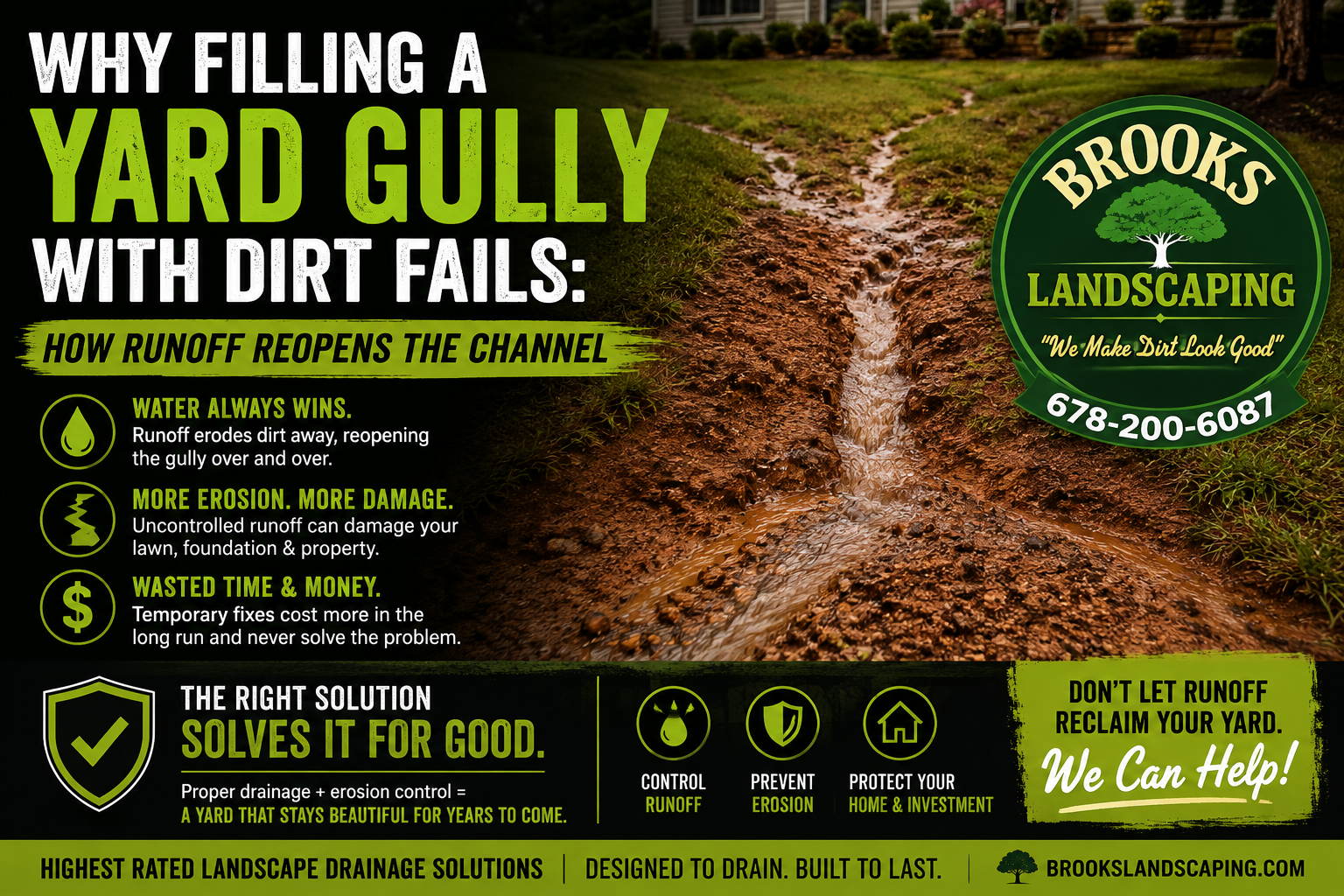
I understand why a homeowner looks at a washout and thinks, “We just need to put the dirt back.”
The channel is missing soil, so adding soil feels obvious. Fill goes in, the yard looks better, and then another hard Georgia rain follows the same path and cuts it open again.
That second washout is not bad luck. It is the yard proving that the repair covered the symptom without controlling the water.
USDA Natural Resources Conservation Service guidance says channels in concentrated-flow areas are often filled or smoothed, then form again after additional runoff. A residential yard is smaller, but the lesson is the same.
You cannot repair moving water with loose dirt alone. You have to understand where the runoff begins, why it concentrates, how it travels, and where it can end safely. That is diagnosis before design.
A Gully Is a Water Path, Not Just a Hole
A gully is an established channel cut by concentrated runoff. It may begin as several shallow rills that merge downhill. It can also start where a downspout, driveway, neighboring slope, swale, or hardscape edge releases too much water onto unprotected soil.
Once the path forms, it keeps receiving water because it is lower than the surrounding ground. Each storm can deepen, widen, or lengthen it.
Unlike broad sheet erosion, a gully shows that runoff has gathered into a concentrated route. The repair must manage that route—not merely replace soil.
Five Reasons Loose Fill Washes Out Again
1. The runoff source never changed
If a gully receives water from downspouts, an uphill yard, a driveway, or a lawn slope, filling it does not reduce that volume.
Before filling anything, I want to know what drains toward the channel and whether several sources combine there.
2. Fresh dirt is vulnerable
New soil has less structure and root reinforcement than established ground. Loosely spread on a slope, it can move quickly. Georgia clay may feel hard when dry but become slick and mobile when saturated.
Compaction matters, but it is not drainage. Even well-placed fill can erode under concentrated runoff.
3. The old channel remains the lowest route
If the repair does not reshape the surrounding grade, the fill may remain the natural low line. Runoff finds it and begins cutting again.
A yard can look level while still directing water toward the same weak area.
4. The upstream edge can migrate
A gully may develop a steep leading edge called a headcut. Water removes soil from its base, allowing the drop to move uphill.
Filling the lower channel without stabilizing the active upper edge may leave the most aggressive part of the erosion untouched.
5. The outlet remains unstable
Even if the upper section is repaired, water needs a dependable destination. A pipe or channel that releases concentrated flow onto bare clay can start a new washout downhill.
The inlet, route, and outlet must work together, or the project merely moves the erosion.
Signs the Gully Is Still Active
Look at the area after rain and watch for:
-
Fresh red sediment below the repair
-
A narrow groove forming through new soil or sod
-
Sod seams lifting or separating
-
A steep edge growing farther uphill
-
Water entering from several small paths
-
Undercut grass, roots, pavers, or wall edges
-
Rock moving or soil washing around its sides
-
Mud reaching a driveway, sidewalk, curb, or neighboring property
A bright new scar or sediment fan often shows where the latest movement occurred.
Take photos or video from a safe location during rainfall. Do not walk into fast runoff, unstable banks, or lightning to document the problem.
What a Lasting Residential Repair Must Address
The right combination depends on the water source, drainage area, slope, soil, nearby structures, and outlet. A residential plan may include several of these steps.
Control concentrated sources first
Roof runoff may need to enter solid underground pipe instead of dumping onto the slope. Surface water may need a correctly placed catch basin, a broad grading adjustment, or an intercepting swale before it reaches the damaged area.
The goal is to keep more water from entering than the repaired path can safely carry.
Reshape the damaged area
Steep, narrow banks can continue collapsing. Depending on the property, the channel may need to be widened, softened, or blended into a broader stable grade. Any fill used must be appropriate for the site, placed correctly, and connected to undisturbed ground—not balanced loosely inside the old cut.
Build a stable conveyance when water must remain visible
If surface runoff naturally needs to cross the yard, a properly shaped dry creek bed can provide a controlled route. Stone selection, depth, channel shape, fabric or separation strategy, and transitions all depend on expected flow and soil conditions.
A decorative stripe of small rock is not automatically erosion control. Water can travel beneath it or cut around the edges.
Protect the outlet
The discharge must slow and spread water without sending it toward a structure, road, easement obstruction, or neighbor. River rock, larger stone, or a stabilized transition may be appropriate.
Restore the surrounding soil and cover
After the water path is controlled, prepared soil and healthy sod can protect repaired slopes from ordinary rainfall and shallow runoff. Sod is the finish and surface armor—not the primary structure for carrying concentrated stormwater.
When Filling and Sodding May Be Enough
Not every groove requires a major system. A shallow rill caused by temporary disturbance may be corrected with grading, soil preparation, and sod—provided concentrated runoff does not continue.
The key question is whether the channel was created by a one-time disturbance or by a repeatable water source.
If the same groove returns after each storm, receives roof or uphill runoff, or is developing defined banks, the site needs more than cosmetic restoration.
Common Gully-Repair Mistakes
Dumping one load of fill into the deepest point
This replaces volume without addressing the grade, entry point, or outlet.
Covering loose fill with sod immediately
Sod can hide settlement and weak soil until water cuts underneath or separates the seams.
Using random rock as a plug
Water may flow around a rock pile, undercut it, or create faster jets between stones. Rock must form part of a continuous stabilized system.
Installing a drain box without shaping the collection area
A catch basin only captures water that reaches its grate. If the surrounding grade bypasses it, the gully can remain active.
Sending the outlet to the property line
A repair should not transfer concentrated water or sediment to the next property.
Building a retaining wall as a shortcut
A retaining wall changes elevations and creates its own drainage requirements. It should not be used simply to hide an active runoff channel.
What Determines the Cost and Scope
I cannot price gully repair responsibly from a single close-up photo. The visible scar is only part of the project.
The major cost factors include:
-
Size of the land area contributing runoff
-
Length, depth, and slope of the channel
-
Access for equipment and material delivery
-
Amount and type of soil that must be removed or replaced
-
Need for downspout piping, catch basins, or regrading
-
Stone size and quantity for a stabilized channel or outlet
-
Proximity to foundations, driveways, walls, utilities, septic systems, and property lines
-
Sod and landscape restoration after drainage work
-
Permitting, easement, or engineering requirements
A cheap-looking repair becomes expensive when it must be repeated after every storm.
Homeowner Checklist Before Repairing a Washout
-
Find where the water first enters the area.
-
Check every nearby downspout and hard surface.
-
Note whether several runoff paths merge.
-
Photograph the channel during and after rain.
-
Look for a growing uphill edge or collapsing sides.
-
Locate the sediment deposit downhill.
-
Identify foundations, walls, utilities, septic areas, and property lines.
-
Review the plat, survey, or deed for drainage easements.
-
Determine whether there is a safe, stable outlet.
-
Avoid adding soil until the flow path is understood.
Safety, Easements, and Local Requirements
Paulding County’s homeowner stormwater guide says property owners may not fill a drainage easement with soil or concrete or alter drainage features there without the required approval. A natural-looking ditch in the backyard may be part of a recorded drainage system, so check the plat or survey before changing it.
Georgia 811 currently instructs homeowners and contractors to submit a locate request at least three business days before mechanized digging and to check utility responses before excavation begins.
Requirements vary by city, county, property, wall height, and project scope. This article is general homeowner education, not a site-specific drainage design, permit decision, or engineering evaluation.
Frequently Asked Questions
Why did the dirt stay in place for weeks before washing out?
Dry weather can make a weak repair appear stable. The real test comes when rainfall produces enough runoff to follow the original channel.
Will compacting the fill stop the erosion?
Compaction improves stability, but it does not remove the water source. Concentrated runoff can erode compacted soil when the path is not protected.
Can sod hold the repair together?
Sod helps protect prepared soil from rainfall impact and shallow surface flow. It should not be expected to carry concentrated water through an active gully.
Should every gully become a dry creek bed?
No. Some sites need source interception, solid piping, catch basins, regrading, or a combination. A dry creek bed is appropriate only when a visible stabilized channel fits the actual flow path and outlet.
When is professional evaluation especially important?
Get help when the channel is growing, receives several water sources, or approaches a foundation, driveway, retaining wall, utility, septic area, property line, drainage easement, or public stormwater feature. Large or unstable failures may require a qualified engineer or local authority in addition to landscape work.
Fix the Water Before You Replace the Dirt
The missing soil is evidence. The water is the cause.
If you replace the soil without changing how runoff enters, travels, and exits the area, the yard will usually cut the same path again. You cannot stop Georgia rain—but you can control where it goes.
Brooks Landscaping evaluates erosion as part of the complete landscape-drainage system. We serve homeowners in Paulding County, Dallas, Hiram, Kennesaw, Acworth, and nearby northwest metro Atlanta.
Call 678-200-6087 or visit BrooksLandscapingGa.com to schedule an evaluation.
Brooks Landscaping — We Make Dirt Look Good™
Landscaping That Solves Problems. Designed to Drain. Built to Last.
Author Box
Greg Brooks, The Dirt Doctor®
Greg Brooks is the founder of Brooks Landscaping and the voice behind MrDirtDoctor.com. For more than 15 years, he has helped Georgia homeowners understand and solve landscape-drainage, grading, erosion-control, retaining-wall, and drainage-focused hardscape problems. His approach begins with reading the land and diagnosing how water moves before recommending a repair.


